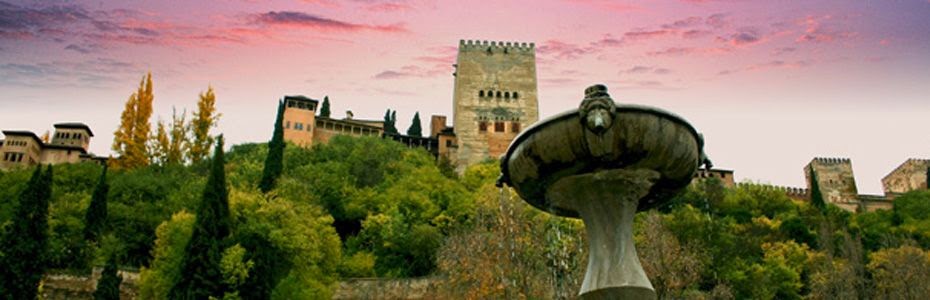

Must see places in Andalusia, Spain

If you are a muslim traveller or an islamic architecture lover those are the 7 things you must see in Granada

Top 10 foods to try in Morocco

One of the great cuisines of the world, Moroccan cooking abounds with subtle spices and intriguing flavour combinations.

Top Five Must See Things in Cordoba, Spain

Cordoba قرطبة in the Andalucia province of southern Spain is a city with more than 2,500 years of developed history.

ChefChaouen, the blue city in Morocco

Located just a few hours by bus from Tangier and far enough off the beaten track to dissuade many tourists, Chefchaouen is quiet enough for those visitors overwhelmed by the busy medinas of Fez and Marrakech, and has just enough of what is quintessentially Moroccan to be of interest to other travelers looking for something a bit more authentic.

Fes, Morocco

The most mystical of Morocco's imperial cities, Fez. Capital and spiritual center of Morocco, this city is situated in a narrow valley against the backdrop of the Middle Atlas

Mostrando entradas con la etiqueta yusuf I. Mostrar todas las entradas

lunes, 17 de noviembre de 2014

Madrasa ﻣﺩﺭﺴة of the Nasrid monarch Yusuf I in Granada

In the first half of the fourteenth century, the Nasrid Sultan Yusuf I ordered the construction of a madrasa next to Granada's congregational mosque.

Fragments from the original façade are preserved in the Museo Arqueológico y Etnológico de Granada, including an inscription, which states that the building was dedicated in the month of Muhurram in 750 (March or April 1349).


It is located on the street now known as Calle Oficios. The madrasa was built at the heart of the city, near the main mosque (now the site of the Granada Cathedral) and the Alcaicería, then the elite bazaar where silk, gold, linen and other cloth were traded. Ibn al-Khatib was an early student there; among his teachers were Ibn al-Fajjar, Ibn Marzuq, and Ibn al-Hayy (language and law); Ibn al-Hakam and the poet Ibn al-Yayyab (rhetoric); and Sheik Yahya ibn Hudayl (medicine and philosophy).

The building

As was typical of the works of Yusuf I, the building was splendid, with a white marble entrance. The building was originally organized around a pool in the center.

The only surviving part of the school is the prayer room. It is a square-shaped room oriented by its mihrab. Carved, polychrome plaster covers the upper portions of the walls and doorjamb. Calligraphy consistent in style and content with other Nasrid monuments is an integral part of the decoration. Muqarnas in the four corners of the room form an upward transition into an octagonal drum that has sixteen windows with pierced screens.

Above the prayer room is an octagonal wooden ceiling with interlaced star shapes, open in the center and topped by a smaller octagonal drum with sixteen windows and a plaster-decorated ceiling. (Segments of the ceiling have been modified during restoration.)

The façade was decorated with inscriptions of poetry and philosophy. Among these were the words "If in your spirit you provide a place for the desire to study and to flee from the shadows of ignorance, you will find in it the beautiful tree of honor. Make study shine like stars to the great, and to those who are not, bring to them the same brilliance."

Baroque façade of the Madrasa of Granada (detail).
After the completion of the Reconquista and the conversion to the Cabildo an adjacent house was Baroque, so that what we have today is essentially an 18th-century building with elements of older buildings. The oratory or mihrab is original from the 14th century; the Sala de los Caballeros XXIV is Mudéjar.

annexed to enlarge the building. The octagonal Mudéjar Sala de Cabildos was constructed in this era; its 1513 decoration included an inscription alluding to the Christian conquest of the city. Eventually the pool was filled in and converted to other uses, although even after the modifications of 1554–1556, Francisco Henríquez de Jorquera describes a patio with a pool and a garden. The building was subject to major modifications, especially in the 1722–1729 at the height of the

The building, which belongs to the University of Granada, underwent extensive archeological excavations in 2006–2007. As of February 2009, restoration of the interior was just beginning, and the building is not currently open to the public.

History

The madrasa is located on this street called Calle Oficios
The Madrasa functioned as a university until late 1499 or early 1500, under the Treaty of Granada (1491), under which the sultan Boabdil of the Emirate of Granada surrendered to the Catholic Monarchs Ferdinand and Isabella. However, towards the end of 1499, the policy of tolerance and compliance with that treaty under archbishop Hernando de Talavera, came to an abrupt end with the arrival in Granada of Gonzalo Jiménez de Cisneros, who substituted a policy of forced religious conversions.

This new policy led to an uprising in Granada, above all in the Albaicín. Cisneros took advantage of the situation to assault the Madrasah, the contents of whose library was brought to the plaza of Bib-Rambla and burned in a public bonfire. Once pillaged and closed, the building was designated in 1500 by Ferdinand II to be the new Casa del Cabildo (city hall).

In 1858 the town hall moved to the Plaza del Carmen, and the building was sold to be used as a textile warehouse. Two years later, the principal inscription of the Mihrab was discovered. There was also some fire damage in this era; the Echeverría family, owners of the building, hired Mariano Contreras, the same architect who restored the Alhambra, to undertake the repairs.

The city bought back the building in the early 20th century, leading to further restoration work in 1939. There was an unsuccessful attempt in 1942 to turn the building into the seat of a new Instituto de los Reyes Católicos del Consejo Superior de Investigaciones Cientificas ("Catholic Monarchs Institute of the Superior Council of Scientific Investigations"). In 1976, the building became part of the University of Granada.

jueves, 13 de noviembre de 2014

The Corral del Carbon, one of the oldest arab monuments in Granada

Located in Calle Mariana Pineda, in the heart of Granada, Corral del Carbon is the oldest monument left us by the Arabs. 

The "Corral del Carbón", formerly called "Alhóndiga Gigida" was constructed in the early 14th century 
by Yusuf I and was used as a type of warehouse for merchandise and also as a shelter for merchants.

It is of special interest because it is the only remaining Moorish caravansara or fundak that still remains as it was in Spain.


The building has a quadrangular shape, with an entrance pavilion which has a large horseshoe arch that gives access to the vestibule which is covered with a cupola embellished with "muqarnas" (decorative motif characteristic of the Muslim architecture, based on vertically juxtaposed bows or prisms). Above the entrance door there is a small twin window. From here we enter the "'ostowan" or waiting vestibule with arches on its sides, that leads to the courtyard surrounded by galleries that open onto the three floors of the building. At the center of the courtyard we find a stone made fountain with two spouts.

The yard is laid out in typical Islamic design, with a symetrical courtyard, mosaic floorings, and a central water trough, which is the original drinking trough.

The paving of black and white stones indicates that this is a prosperous area, with the function of keeping down the dust from the floor. The black stones were gathered from the River Genil and the white from the River Darro

There is a government run craft/ Art shop housed in one of the buildings surrounding the courtyard, these were originally stables, used to house the mules of the merchants.

The upper galleried rooms were originally used by the merchants for making buisness deals, socialising and sleeping.

In Christian times it was used as an accommodation for coal merchants, from where it gets its name. Later, it became a playhouse for comedies, and finally, a neighbourhood until 1933 when the State acquired it and the architect "Leopoldo Torres Balbás" restored it.