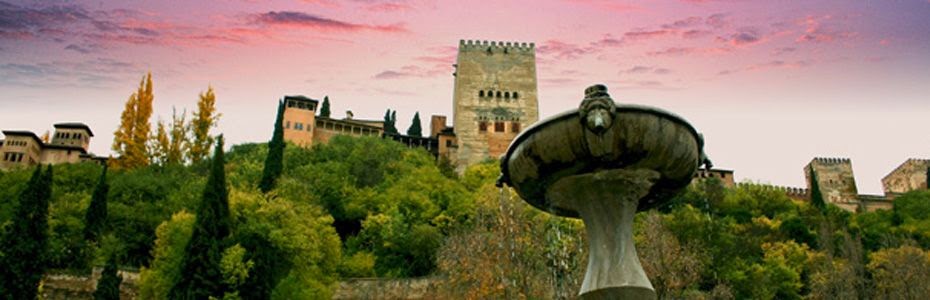
Must see places in Andalusia, Spain

If you are a muslim traveller or an islamic architecture lover those are the 7 things you must see in Granada

Top 10 foods to try in Morocco

One of the great cuisines of the world, Moroccan cooking abounds with subtle spices and intriguing flavour combinations.

Top Five Must See Things in Cordoba, Spain

Cordoba قرطبة in the Andalucia province of southern Spain is a city with more than 2,500 years of developed history.

ChefChaouen, the blue city in Morocco

Located just a few hours by bus from Tangier and far enough off the beaten track to dissuade many tourists, Chefchaouen is quiet enough for those visitors overwhelmed by the busy medinas of Fez and Marrakech, and has just enough of what is quintessentially Moroccan to be of interest to other travelers looking for something a bit more authentic.

Fes, Morocco

The most mystical of Morocco's imperial cities, Fez. Capital and spiritual center of Morocco, this city is situated in a narrow valley against the backdrop of the Middle Atlas

Mostrando entradas con la etiqueta islamic tour. Mostrar todas las entradas

lunes, 22 de febrero de 2016

Dar al Horra Palace - Islamic things you must visit in Granada


Picture shared via http://alhambracadabra.blogspot.com.es


Text via www.granadatur.com 

It was built in the 15th century on the remains of the destroyed palace of the Ziri kings. It very interesting as it is the only one, out of several which were in the Albayzin, which has been preserved. The name “Dar-al-horra” (House of the Honest Lady) seems to honour one of its inhabitants: Aisha, the mother of King Boabdil, the last of the Muslim monarchs in Spain.

After the conquer of Granada in 1492 by the Catholic Monarchs, the Muslims ceded the Palace an the surrounding houses to the Kings’ secretary, Hernando de Zafra. Afterwards, Queen Isabella decided to found ther the Santa Isabel la Real Convent. The building was owned by the religious order until the beginnings of the 20th century when it was purchased by the government. Today it has been catallogued as Heritage of Cultural Interest.


Picture shared via http://alhambracadabra.blogspot.com.es

Its structure and decoration is the characteristic of the Nasrid art. It has two floors in two of its sides and a tower in its North side. We can admire a central courtyard or patio, two “porticos” in the lower sides and a little pool with fountain by the South portico.

Picture shared via http://alhambracadabra.blogspot.com.es

The North side is the most interesting in the building; it has two floors and a tower. On the ground floor, the portico is formed by three horseshoe’s archs on columns and it is covered by a magnificent Arab-style ceiling made of simple wood and decorated with geometrical shapes. 

In the centre a door with horseshoe arch gives access to a rectangular hall with side rooms and a watchpoint in the centre from where one can see part of the district. The different rooms are divided with archs and covered by Arab-style ceilings. In some walls there still are some Arabic inscriptions.

lunes, 22 de diciembre de 2014

De l'Espagne au Portugal l'héritage d'Al Andalus

Pendant près de sept siècles, Al-Andalus a formé un foyer culturel incontournable de l'Europe médiévale. Nourries des traditions chrétiennes, juives et musulmanes, ces terres portent une histoire riche, que Patrick de Carolis invite à découvrir. De Cordoue à Grenade, en passant par Evora, Mértola, Tolède, Jerez de la Frontera, ou encore Séville, ce voyage permet de plonger au coeur de l'histoire de la péninsule ibérique. 


martes, 16 de diciembre de 2014

Top Five Must See Things in Cordoba, Spain

Cordoba قرطبة in the Andalucia province of southern Spain is a city with more than 2,500 years of developed history. Established around the 8th century BC, Cordoba at one point was probably the world’s most populous city. Today, with only around 325,000 inhabitants, it’s actually one of the smaller cities in Spain but that doesn’t stop it being one of Spain’s most visited cities.
Cordoba is not only historic and beautiful, there are also so many things to see and do it’s often difficult to choose. If you are planning a first trip to Cordoba, or even a second or third one and haven’t seen every must see place on previous trips, there are five must see things everyone who visits Cordoba should see.

You can visit Cordoba in our Spain & Morocco Tour and Andalusia Routes

1. Great Mosque of Cordoba/Mezquita-Catedral 
 One of the most beautiful mosques in Spain, the Great Mosque of Cordova, or Mezquita-Catedral (Mosque Catheddral) is a World Heritage Site known for its stunning architecture. It is the world’s third largest mosque, although today it is used as a Roman Catholic church. Muslims in Spain have been lobbying the Spanish government since the year 2,000 to be allowed to pray in the mosque, but so far have been denied permission.
Construction on the mosque began in the year 785.

2. Alcazar
 The big attraction here are the gardens, laid out in descending terraces with typical Islamic rectangular pools - some of the most beautiful in Andalucia - perfect for a cooling waterside break on a hot spring day.


3. The Jewish Quarter "La Juderia"
The Jewish quarter of Cordoba goes back to the time of the Romans and consists of a network of narrow streets full of shops, restaurants and cafes, synagogues and museums. A must see is the Bullfight Museum and don’t miss the Zoco, where in the summer you can see flamenco dancers performing. You can visit too the 14th century synagogue and a restored Sefardi house. 


4. The Calahorra Tower and its "Al-Andalus living museum"
 The Al-Andalus living museum is located in an old Moorish fortress, and recreates the time of maximum splendour in this Andalusian city. The museum is in the Calahorra Tower, opposite the Great Mosque, at the end of the Roman Bridge. Its aim is to provide a recreation of the Cordoba of the period between the 9th-13th centuries.

5. ‎ Madīnat az-Zahrā  مدينة الزهراء 
 Medina Azahara (Arabic: مدينة الزهراءMadīnat az-Zahrā: literal meaning "city of the flower") is the ruins of a vast, fortified Arab Muslim medieval palace-city built by Abd-ar-Rahman III al-Nasir, (912–961) Umayyad Caliph of Córdoba, and located on the western outskirts of Córdoba, Spain. It was an Arab Muslim medieval town and the de facto capital of al-Andalus, or Muslim Spain, as the heart of the administration and government was within its walls. Built beginning in 936-940, the city included ceremonial reception halls, mosques, administrative and government offices, gardens, a mint, workshops, barracks, residences, and baths.

lunes, 15 de diciembre de 2014

مدينة الزهراء‎ Madīnat az-Zahrā The city of the flower

When you go to Córdoba, besides visiting the city, you must visit the archeological remains of Medina Azahara, one of the great works of Islamic art in Andalucía.


Medina Azahara (Arabic: مدينة الزهراءMadīnat az-Zahrā: literal meaning "city of the flower") is the ruins of a vast, fortified Arab Muslim medieval palace-city built by Abd-ar-Rahman III al-Nasir, (912–961) Umayyad Caliph of Córdoba, and located on the western outskirts of Córdoba, Spain. It was an Arab Muslim medieval town and the de facto capital of al-Andalus, or Muslim Spain, as the heart of the administration and government was within its walls. Built beginning in 936-940, the city included ceremonial reception halls, mosques, administrative and government offices, gardens, a mint, workshops, barracks, residences, and baths. Water was supplied through aqueducts.

10,000 men worked in its construction using the best materials: precious metals, marble, polychrome stones, etc.

Medinat-al-Zahra was organized in three big terraces surrounded by a wall. In the upper part was the royal palace, with the rooms of the caliph and his family; the middle one was the bureaucratic and administrative area, with the halls and gardens; the lower one was destined for the houses of the people, as well as for the souk and mosque.

Its location in the foothills of Sierra Morena made it possible to design an urban program in which the location and physical relationships between the various constructions were expressive of the role of each in the setting.

The palace was located at a higher level, and staggered its buildings along the side of the mountain in an expression of clear preeminence over the urban hamlets and the Aljama Mosque spread across the plains below.

Following the terraces, the first corresponds to the residential area of the caliph, next comes the official area including the houses of the viziers, the guard-room, administrative offices and gardens.

Next is the city proper, with housing, crafts, and the great mosque of the two lower terraces separated by another wall in order to isolate the upper palace complex. Archaeological research has revealed an urban morphology characterized by the existence of large areas of undeveloped land, which serves to empty the entire southern front of the fortress, ensuring privacy and maintaining an open, idyllic country landscape.

The only spaces built on the lowest level are two broad bands: the western, with an urban management orthogon, and the eastern, with less rigid planning.

Popular legend holds that the Caliph named az-Zahra, or Azahara, after his favorite concubine, and that a statue of a woman stood over the entrance. Others, imagining his demanding lover, say that he built this new city just to please her. The truth, however, has probably more to do with politics than love.

 Abd ar-Rahman III ordered the construction of this city at a time when he had just finished consolidating his political power in the Iberian Peninsula and was entering into conflict with the Fatimid dynasty for the control of North Africa.

 Zahara means 'shining, radiant or blossoming' in Arabic: the name communicates aspirations of power and status, not romantic love. Az-Zahra is the most common title for the daughter of the Prophet Muhammad Fatimah az-Zahra. As such, the Fatimid dynasty of North Africa adorned many buildings and even towns with her name.


lunes, 17 de noviembre de 2014

Madrasa ﻣﺩﺭﺴة of the Nasrid monarch Yusuf I in Granada

In the first half of the fourteenth century, the Nasrid Sultan Yusuf I ordered the construction of a madrasa next to Granada's congregational mosque.

Fragments from the original façade are preserved in the Museo Arqueológico y Etnológico de Granada, including an inscription, which states that the building was dedicated in the month of Muhurram in 750 (March or April 1349).


It is located on the street now known as Calle Oficios. The madrasa was built at the heart of the city, near the main mosque (now the site of the Granada Cathedral) and the Alcaicería, then the elite bazaar where silk, gold, linen and other cloth were traded. Ibn al-Khatib was an early student there; among his teachers were Ibn al-Fajjar, Ibn Marzuq, and Ibn al-Hayy (language and law); Ibn al-Hakam and the poet Ibn al-Yayyab (rhetoric); and Sheik Yahya ibn Hudayl (medicine and philosophy).

The building

As was typical of the works of Yusuf I, the building was splendid, with a white marble entrance. The building was originally organized around a pool in the center.

The only surviving part of the school is the prayer room. It is a square-shaped room oriented by its mihrab. Carved, polychrome plaster covers the upper portions of the walls and doorjamb. Calligraphy consistent in style and content with other Nasrid monuments is an integral part of the decoration. Muqarnas in the four corners of the room form an upward transition into an octagonal drum that has sixteen windows with pierced screens.

Above the prayer room is an octagonal wooden ceiling with interlaced star shapes, open in the center and topped by a smaller octagonal drum with sixteen windows and a plaster-decorated ceiling. (Segments of the ceiling have been modified during restoration.)

The façade was decorated with inscriptions of poetry and philosophy. Among these were the words "If in your spirit you provide a place for the desire to study and to flee from the shadows of ignorance, you will find in it the beautiful tree of honor. Make study shine like stars to the great, and to those who are not, bring to them the same brilliance."

Baroque façade of the Madrasa of Granada (detail).
After the completion of the Reconquista and the conversion to the Cabildo an adjacent house was Baroque, so that what we have today is essentially an 18th-century building with elements of older buildings. The oratory or mihrab is original from the 14th century; the Sala de los Caballeros XXIV is Mudéjar.

annexed to enlarge the building. The octagonal Mudéjar Sala de Cabildos was constructed in this era; its 1513 decoration included an inscription alluding to the Christian conquest of the city. Eventually the pool was filled in and converted to other uses, although even after the modifications of 1554–1556, Francisco Henríquez de Jorquera describes a patio with a pool and a garden. The building was subject to major modifications, especially in the 1722–1729 at the height of the

The building, which belongs to the University of Granada, underwent extensive archeological excavations in 2006–2007. As of February 2009, restoration of the interior was just beginning, and the building is not currently open to the public.

History

The madrasa is located on this street called Calle Oficios
The Madrasa functioned as a university until late 1499 or early 1500, under the Treaty of Granada (1491), under which the sultan Boabdil of the Emirate of Granada surrendered to the Catholic Monarchs Ferdinand and Isabella. However, towards the end of 1499, the policy of tolerance and compliance with that treaty under archbishop Hernando de Talavera, came to an abrupt end with the arrival in Granada of Gonzalo Jiménez de Cisneros, who substituted a policy of forced religious conversions.

This new policy led to an uprising in Granada, above all in the Albaicín. Cisneros took advantage of the situation to assault the Madrasah, the contents of whose library was brought to the plaza of Bib-Rambla and burned in a public bonfire. Once pillaged and closed, the building was designated in 1500 by Ferdinand II to be the new Casa del Cabildo (city hall).

In 1858 the town hall moved to the Plaza del Carmen, and the building was sold to be used as a textile warehouse. Two years later, the principal inscription of the Mihrab was discovered. There was also some fire damage in this era; the Echeverría family, owners of the building, hired Mariano Contreras, the same architect who restored the Alhambra, to undertake the repairs.

The city bought back the building in the early 20th century, leading to further restoration work in 1939. There was an unsuccessful attempt in 1942 to turn the building into the seat of a new Instituto de los Reyes Católicos del Consejo Superior de Investigaciones Cientificas ("Catholic Monarchs Institute of the Superior Council of Scientific Investigations"). In 1976, the building became part of the University of Granada.