
Must see places in Andalusia, Spain

If you are a muslim traveller or an islamic architecture lover those are the 7 things you must see in Granada

Top 10 foods to try in Morocco

One of the great cuisines of the world, Moroccan cooking abounds with subtle spices and intriguing flavour combinations.

Top Five Must See Things in Cordoba, Spain

Cordoba قرطبة in the Andalucia province of southern Spain is a city with more than 2,500 years of developed history.

ChefChaouen, the blue city in Morocco

Located just a few hours by bus from Tangier and far enough off the beaten track to dissuade many tourists, Chefchaouen is quiet enough for those visitors overwhelmed by the busy medinas of Fez and Marrakech, and has just enough of what is quintessentially Moroccan to be of interest to other travelers looking for something a bit more authentic.

Fes, Morocco

The most mystical of Morocco's imperial cities, Fez. Capital and spiritual center of Morocco, this city is situated in a narrow valley against the backdrop of the Middle Atlas

Mostrando entradas con la etiqueta tour. Mostrar todas las entradas

miércoles, 1 de abril de 2015

Travel the halal way... and discover the Great Mosque of Cordoba

THE GREAT MOSQUE OF CORDOBA, universal symbol of Moorish heritage in Spain, and one of history's most extraordinary works of art, awaits you in Cordoba.

Come and admire this architectural jewel - a unique space made up of forms, light, columns and colours, where you will feel all the splendour of ancient Al-Andalus.
Visit "Andalusia routes" or our Spain & Morocco Tour in our website and send your request trip for more information.

Puente Romano, Cordoba, SpainThe Mosque-Cathedral of Cordoba is the most important monument of all the Western Islamic world, and one of the most amazing in the world. The evolution of the “Omeya” style in Spain is resumed in the history of the Mosque of Cordoba, as well as other styles such as the Gothic, Renaissance and Baroque of the Christian architecture.

It seems as if the place that the Mosque-Cathedral of Cordoba occupies nowadays was dedicated, from ancient times, to the cult of different divinities. In this same place, and during the Visigoth occupation, another building was constructed, the “San Vicente” Basilic.

On top of this basilic and after paying half of the site, the primitive Mosque was constructed. This basilic, of rectangular shape, was shared for a period of time between Moslems and Christians.

After the Muslim enlargement, the Basilic became property of Abderraman I, who destroyed it to construct the first “Mosque Alhama” or main Mosque of the city. Nowadays, some of the constructive elements of the Visigoth building are integrated in the first part of Abderraman I.

The Great Mosque has two different areas: the courtyard or “arcade sahn“, where the “alminar” (minaret) is constructed (beneath the Renaissance tower) by Abd al-Rahman III, and the “haram” or praying hall.

The interior space consists of a forest of columns and red and white arches giving a strong chromatic effect. The site is divided into 5 different areas, corresponding each one of them to the different expansions that have occurred on it.

In planning the mosque, the architects incorporated a number of Roman columns with choice capitals. Some of the columns were already in the Gothic structure; others were sent from various regions of Iberia as presents from the governors of provinces. Ivory, jasper, porphyry, gold, silver, copper, and brass were used in the decorations. Marvellous mosaics and azulejos were designed. Panels of scented woods were fastened with nails of pure gold, and the red marble columns were said to be the work of God. The primitive part of the building, erected under the direction of Abd-er-Rahman I., was that bordering the Court of Oranges. Later, the immense temple embodied all the styles of Morisco architecture into one composition.
 
The Great Mosque of Córdoba held a place of importance amongst the Islamic community of al-Andalus for three centuries. In Córdoba, the capital, the Mosque was seen as the heart and central focus of the city. Muhammad Iqbal described its hypostyle hall as having "countless pillars like rows of palm trees in the oases of Syria". To the people of al-Andalus "the beauty of the mosque was so dazzling that it defied any description."

The main hall of the mosque was used for a variety of purposes. It served as a central Prayer hall for personal devotion, the five daily Muslim prayers and the special Friday prayers. It also would have served as a hall for teaching and for Sharia Law cases during the rule of Abd al-Rahman & his successors.


The Great Mosque of Córdoba exhibited features, and an architectural appearance, similar to the Great Mosque of Damascus, therefore it is evident that it was used as a model by Abd al-Rahman for the creation of the Great Mosque in Córdoba.

Layout

The building's floor plan is seen to be parallel to some of the earliest mosques built from the very beginning of Islam. It had a rectangular prayer hall with aisles arranged perpendicular to the qibla, the direction towards which Muslims pray. The prayer hall was large, flat, with timber ceilings held up by arches of horseshoe-like appearance.


One hundred fifty years following its creation, a staircase to the roof was added, along with a southward extension of the mosque itself. A bridge was built linking the prayer hall with the Caliph’s palace. The mosque was later expanded even further south, as was the courtyard which surrounded it.

The mosque was built in four stages, with each Caliph and his elite contributing to it.


Until the 11th century, the courtyard was unpaved earth with citrus and palm trees irrigated - at first by rainwater cisterns, and later by aqueduct.

Excavation indicates the trees were planted in a pattern, with surface irrigation channels. The stone channels visible today are not original.


Abd-er-Rahman III added a new tower. The minaret contained two staircases, which were built for the separate ascent and descent of the tower. On the summit there were three apples, two of gold and one of silver, with lilies of six petals.

The minaret is four-faced, with fourteen windows, having arches upon jasper columns, and the structure is adorned with tracery.


viernes, 7 de noviembre de 2014

Documentary in Arabic: The Alhambra, an Andalusi palatine city in Granada (Spain). قصر الحمراء. التراث نظري.


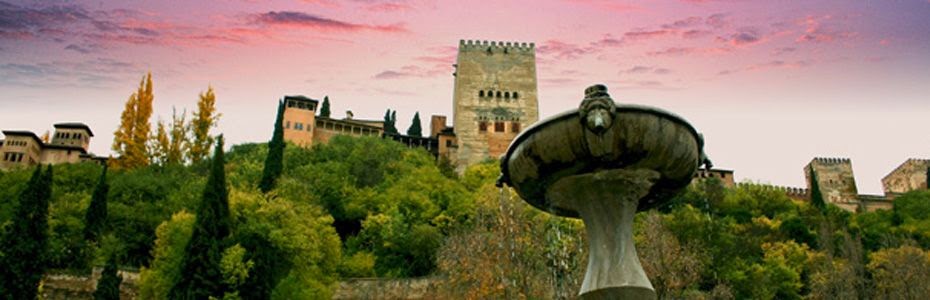
The Alhambra, in Granada, Spain is one of the most evocative buildings I've ever visited in my life. It's an absolute must-visit for any traveller to Andalucia - the biggest province in Southern Spain.
The Alhambra was an Arabic fortress built while the Moors (Muslims from North Africa) still laid claim to this part of Spain - back in the c13th or so.

"Alhambra" is a Spanish rendering of the Arabic words "qa'lat al-Hamra", meaning "red castle". The significance of the "red" part is easy to see, as it comes from the dusty red stone that was used to build the thick walls around the castle.

The entire site has got a magic feeling to it - a raise-the-hairs-on-the-back-of-your-neck kind of buzz that envelops you from the moment you begin the steep climb to its entrance-way.
The Alhambra rustles with incredible Arabic myths, and is filled with the whispers of ghosts from times gone by. It's staggeringly beautiful, and feels like a creation from an old story-book, miraculously brought to life.

The setting is also like something from a picture postcard. The Alhambra stands proudly atop of one of the steep vantage-points of Granada - a hill called La Sabika.

The castle lurks behind blood-red boundary walls, and is framed against the snowy peaks of the Sierra Nevada mountain-range, some distance behind.


sábado, 14 de diciembre de 2013

Cordoba, where cultures come together

Over the centuries, the different peoples and cultures who settled in Cordoba left a priceless legacy of monuments in the streets of the city. If you come to southern Spain, then make a note to visit this destination. This city in Andalusia had all of Europe in awe during the Middle Ages. When you see its stunning heritage, you will understand why.

Its historic quarter has been declared a World Heritage Site by the UNESCO, although the main protagonist is actually the Great Mosque. It is considered the most important Islamic monument in the West, and is doubtless one of the world's most fascinating works of art. Its "forest" of columns, its two-tone arches and its decor, along with the Gothic, Renaissance and Baroque elements of the Christian cathedral built within it make this a unique, stunning architectural site.

Besides the Great Mosque you will find other magnificent buildings in this city. A gentle stroll around the historic centre will take you to the Alcázar (Palace) of the Christian Monarchs, with its beautiful gardens, its Moorish baths, and the Mosaic Room, where you can see the wonderful collection ofRoman mosaics found beneath Plaza de la Corredera Square. Head for the narrow streets of the Jewish Quarter where you can admire the beautiful plasterwork of its Synagogue. Also worth visiting are the Medina Azahara archaeological site, the typical Cordoba patios at Viana Palace, the Potro Inn, mentioned in "Don Quixote", the Baroque Merced Convent, Calahorra Tower...

In Spain, enjoying art and culture is an unforgettable experience. In Cordoba too: start planning your holiday and come and see for yourself.

sábado, 9 de noviembre de 2013

Travel the halal way.... and discover the ALCÁNTARA القنطرة BRIDGE (Toledo)


The word Alcántara comes from Arabic القنطرة (al-qanţarah), which means "bridge". 

The Alcantara Bridge was part of the defensive enclosure of the city of Toledo. Of Roman origin, around the year 788, is constructed as confluence of roads seeking passage to the city from the east, across the Tajo River. 

It was rebuilt under the leadership of Almanzor and, according to its inscription, was completed in 997 by Alef, his son, governor/alcaide of Toledo

From that time only retains the spur opposite side of the city, made of masonry. It still has decorative marbles Visigoths.

Later it was restored several times, one of them, the most important by Alfonso X, who built the Moorish tower of the western end and was later modified by the Catholic Monarchs in 1484. In the west side, the bridge has a fortified gate with battlements at its base and crown, consisting of a semicircular arch which included another horseshoe arch, and decorated with the statue of San Ildefonso and the shield of the Kings Catholics.

On the east side retains the Alcantara door (Bab al Yayl, means Horse's Gate), of Arab origin, built in the tenth century with significant christians interventions.

The bridge rests on two arches, the largest center, under which flows the River Tajo.


If you want to travel here send a request trip to +Alhamra Tour