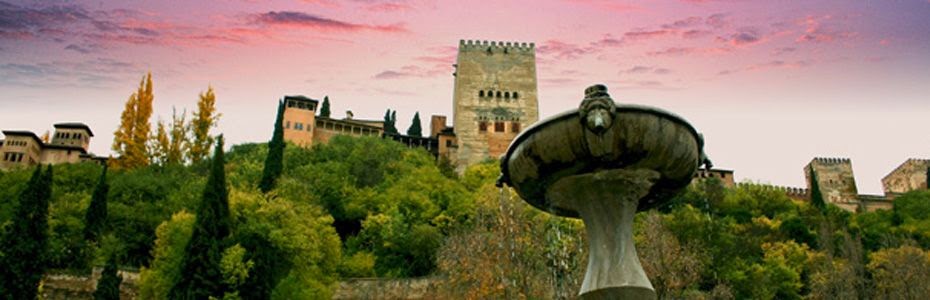
The Alhambra
The Alhambra was built on top of the
Sabikah
Hill, which cuts into a fertile valley and stands as the last bastion
of the Sierra Nevada mountain mountains, in front of
Albaycin and
Sacromonte, between the Darro and Genil rivers.
Arab writers compared Granada, which is surrounded by mountains, to a crown, with the diadem of the Alhambra on top.
The history of the buildings of the Alhambra is
closely related to that of the buildings of the city of Granada. There
are archaeological documents that testify the successive superposition
of Iberian, Roman, and Muslim walls.
The Alhambra today was not built in a single time
period. It was progressively constructed, with the addition over time of
new buildings that were built in groups like cells, enriching the
architectural and urban development of the citadel.
It is the result of an evolutionary process over
more than two and a half centuries, during the reign of the Nasrids, and
includes structures predating that time as well as important
contributions and modifications during the Christian era, which
continues to this day.
The Alhambra: Part fortress (the
Alcazaba), part palace (
Palacios Nazaries), part garden (the
Generalife) and part government city (the
Medina), this medieval complex overlooking Granada is one of the top attractions in Spain, with many visitors coming to Granada expressly to see the Alhambra.
The last Moorish stronghold in Europe, the Alhambra reflects the splendor of Moorish civilization in Andalusia and offers the visitor splendid ornamental architecture, spectacular and lush gardens, cascading and dripping water features, and breathtaking views of the city.

The Alhambra was a palace, citadel, fortress, and the home of the Nasrid sultans, high government
Palace of Charles V, which houses the Alhambra Museum (with historical artifacts from the site) and the Fine Art Museum.
officials, servants of the court and elite soldiers from the 13th to the 14th century. Other notable buildings belonging to a different time period are also located within the Alhambra complex, most notably the Renaissance style
But in order to fully appreciate the unique architecture of the Alhambra set within the surrounding landscape, it is advisable to see the Alhambra for afar as well as up close: several locations in the
Albaizín (most notably the San Nicolás Viewpoint) or Sacromonte - both covered below - allow you the opportunity to truly admire the Alhambra's spectacular location, lying just above the city of Granada.
The Alhambra is a vast complex, composed of many structures and gardens on its lush grounds, which alone are worth exploring - it is totally free to do so and they are open nearly all hours of the day - but there are four primary attractions: the
Alcazaba, the
Palace of Charles V, the
Palacios Nazaries and the
Generalife.
Alcazaba.

The ruins of a massive fortress perched atop the crest of the hill overlooking the city, this is the oldest part of the Alhambra and offers some of the finest views of anywhere in the complex, with an expansive panorama from the top of the prominent tower that gives you a spectacular view of nearly the entire city and the Sierra Nevada mountains.
Within the fort's walls are the ruins of a town which once held soldier's homes and baths, though today only the outline of these rooms remain.
Palace of Charles V (Palacio de Carlos V).
A more recent addition to the Alhambra, this sixteenth century building was commissioned following the Reconquista by
Charles V as a royal residence close to the Alhambra palace.
The square two-level structure is done in Renaissance style with an impressive circular courtyard ringed by a colonnade within.
The building is also home to two museums, the Museo de la Alhambra on the lower floor with a collection of artifacts and art from the Alhambra, and the Museo de Bellas Artes, a small fine art museum on the upper floor, as well as a couple of changing museum exhibits which regularly feature art with some connection to the Alhambra.
Palacios Nazaries.

The Nasrid royal palace and the primary (and thus most crowded) attraction of the Alhambra
Mexuar, a set of administrative rooms with a beautiful prayer room and a small square courtyard with the golden
Façade of Comares, before emerging in the
Court of the Myrtles, a rectangular courtyard with a long pool of water flanked on each side by a myrtle hedge (hence the name). At the end of the courtyard you can enter a room to view the twelve Lion Statues from the
fountain in the
Court of the Lions, .
Visitors get to see spectacular archways and windows, carved wooden ceilings, intricate molded-plaster work and colorful ceramic tiles at nearly every turn as they meander between lovely rooms and lush courtyards. Everyone starts their tour in the
Cross to the other end of the
Court of the Myrtles to enter the
Ship Room, with its spectacular carved wooden ceiling in the shape of an upside-down hull, and the
Chamber of the Ambassadors, the palace's largest and perhaps most spectacular room, which once functioned as the throne room and features a star-studded wooden ceiling, intricately carved stucco walls and beautiful arched windows.

From here you'll pass through a series of small rooms, including the
Washington Irving Room, where Washington Irving wrote
Tales of the Alhambra, as well as down an open-air hallway with an excellent view of an adjacent courtyard (the Court of Linda-Raja) and the Albayzín. Passing by the old bath house you'll enter the
Hall of the Two Sisters, a spectacular domed room with an intricate stucco ceiling and lovely views of the
Court of Linda-Raja. From here you can navigate around the edge of the
Court of the Lions to the
Hall of the Abencerrages, structurally similar to the
Hall of the Two Sisters. At this point you can exit the palace, which will place you near the entrance to the
Partal Gardens.
Generalife.

The lush and gorgeous gardens of the Nasrid kings, the expansive Generalife is the finest set of Moorish style gardens in Andalusia, positioned on a hill situated at the rear of the complex overlooking the Alhambra palace.
Within you'll find beds of colorful flowers, more exquisite architecture, leaping fountains and cool shade. There are two entrances to the Generalife, one at the ticket booth on the east side of the complex and another next to the Palacios Nazaries which will take you through the
Partal Gardens, a collection of palace gardens with flowing water streams and a large pool of water which reflects a nearby portico.
From the Partal you can follow the
Promenade of The Towers, the remains of the main wall and its adjoining towers that separate the Alhambra palace grounds from the
Generalife. As you cross a bridge over a small canyon you'll enter the
Generalife proper, where you can follow a promenade past the amphitheater to the Lower Gardens, a collection of hedge rows with rectangular ponds at the center and colorful flower beds throughout.
Past this is the
Generalife Palace, the white structure sitting atop the hill and the highlight of a visit to the gardens, for it is within that you will find spectacular views, lovely architecture, and the much-photographed
Court of the Main Canal, with its crossing jets of water that arc over the rectangular pool. Nearby is the
Soultana's Court, another picturesque courtyard with leaping fountains.
Above the palace are the High Gardens, where you can find a gorgeous long pergola and the Water Stairway, which true to its name is a beautiful stairway with water flowing down its parapets. The gardens are huge, but the layout is simple as everything in the Generalife can be seen along a long, circular path.
Granada
These are the four primary attractions, but the grounds hold many secondary sights as well, some of them quite splendid in their own right and many off the beaten path. If entering the Alhambra on foot from
Plaza Nueva, you'll travel up
Cuesta de Gomerez through the
Granada Gate, an ornamental archway which marks the entrance to the grounds. From here you can continue straight into the Bosque (forest), a delightfully lush and shady wooded area in the canyon beneath the palace complex with streams running along the footpaths, fountains and statues and, in the summertime, fragrant smells from the trees.

If you take the rightmost path up the hill and make a right up the next path you find, you'll come across the
Bermejas Towers, an outpost of the
Alhambra on the very edge of the complex, with massive square towers perched on a hill over the neighborhood of
Realejo.
The towers themselves are locked up and mostly in ruins, but the views of Granada and the Alhambra are splendid. If you take the leftmost path from the Granada Gate you'll travel up to the
Justice Gate (Puerta de Justica), an imposing Moorish-style archway and entry that served as the primary entrance to the palace complex in days of old.
Within the main palace complex, just above the
Justice Gate is a lovely courtyard area, the
Square of the Cisterns (Plaza de los Aljibes) between the
Alcazaba and the
Palace of Charles V next to the
Wine Gate (Puerta del Vino), another picturesque horseshoe-shaped archway which once protected the grounds. Continuing along the small road past the
Palace of Charles V to the upper part of the palace complex, you'll come across a line of woodworking and souvenir shops, the prominent
St. Mary Church, the ruins of a village and the Parador. Though most of the Parador is a restaurant and hotel, parts are still open to the public, including the lovely courtyard entryway and the ruins of a Franciscan monastery, which holds the lovely remains of a small chapel with a view into the hotel's lavish patio area.

Above the main palace complex, to the east of the
Generalife, are a number of visitor facilities, namely a large parking lot. A short hike uphill from the parking lot is the
Silla del Moro, the ruins of a guard outpost directly above the
Generalife Palace.
While it requires an uphill hike and is isolated from the rest of the grounds, the Silla offers what may be the most spectacular view in all of Granada, giving you a rare opportunity to look down at the Alhambra palace, as well as a sweeping vista of the city, the valley and the surrounding mountains, with the added benefit of not being nearly as crowded as the
San Nicolas Viewpoint in the
Albayzín or requiring admission like the
Alcazaba.
Albayzín