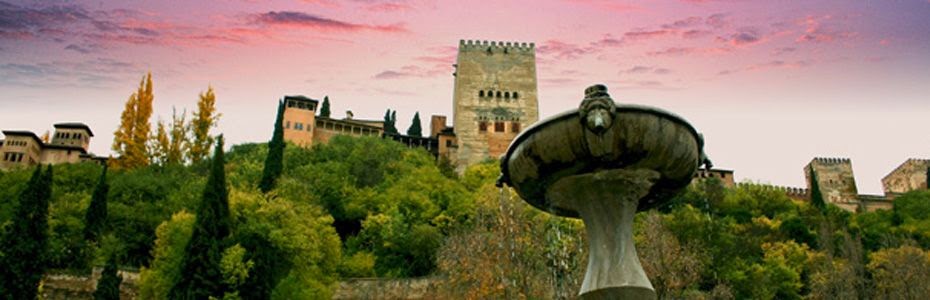
If you are a muslim traveller or an islamic architecture lover those are the 7 things you must see in Granada
The Alhambra
The Alhambra was a palace, citadel, fortress, and the home of the Nasrid sultans, high government Palace of Charles V, which houses the Alhambra Museum (with historical artifacts from the site) and the Fine Art Museum.
The Alhambra reflects the splendor of Moorish civilization in Andalusia and offers the visitor splendid ornamental architecture, spectacular and lush gardens, cascading and dripping water features, and breathtaking views of the city.
The Albaizín is the old Arabic quarter
 Albaycin
 is the old Arab Quarter. It comprises approximately the area between the hill of
the
Alhambra,
the hill of San Cristobal, the
Sacromonte and Elvira. It was declared a
world heritage site in 1984, along with the more famous Alhambra.
The
Albaycin is a wonderful neighborhood to explore
on foot. While strolling along the whitewashed streets, visitors can
admire old Moorish homes, beautiful fountains, and attractive plazas.
Among the more renowned plazas is the Plaza de San Nicolas. It is at
this plaza that the
Mirador de San Nicolas can be found. This "mirador,"
or lookout point, offers amazing views of the
Alhambra, especially at sunset.
The
Next to the Mirador de San Nicolas you can visit
the
Mosque of Granada wich signals, after a hiatus of 500 years,
the restoration of a missing link with a
rich and fecund Islamic contribution
to all spheres of human enterprise and activity.
The
Mosque of Granada is composed of
three main, contrasting elements. These
are the prayer hall (which is properly speaking
the mosque itself), the Centre for Islamic
Studies, and the garden wich looks out over
the valley of the River Darro towards a
vista of the
Alhambra standing on the Mount of Sabika, etched
against the peaks of the Sierra Nevada
 Along Calderia Vieja and Calderia Nueva, twisting antique lanes
climb the hill into the heart of the old Muslim district of the
Albaizín, where Arab shops offer handmade crafts from Morocco, sweets
from Jerusalem, and pungent Arabian spices. Softly lit tea houses
promise mint tea and water pipes, evoking the hospitality of ancient
Persia.
The Banuelo baths, the old arab baths in Granada
Arab baths, the Banuelo, also known as Aammim Alyawza (Banos del Nogal) are located at the bottom of a private house in the
Carrera del Darro,
at the foot of the
Alhambra, and show how skilled the
Spanish Arabs were a thousand years ago. In 1918,
The Banuelo was declared a National Monument and was restored
by the architect Balbas. Surprises to be found in
The Banuelo are their
large size and good level of conservation. Beautiful porticos are based
on the Arab style.
Corral del Carbon, one of the oldest arab monuments in Granada
 Located in Calle Mariana Pineda, in the heart of Granada, Corral del Carbon
is the oldest monument left us by the Arabs.
Located in Calle Mariana Pineda, in the heart of Granada, Corral del Carbon
is the oldest monument left us by the Arabs.
The "Corral del Carbón", formerly called "Alhóndiga Gigida" was
constructed in the early 14th century by Yusuf I and was used as a type of
warehouse for merchandise and also as a shelter for merchants.
It is of special interest because it is the only remaining Moorish
caravansara or fundak that still remains as it was in Spain.
Madrasa ﻣﺩﺭﺴة of the Nasrid monarch Yusuf I in Granada

It is located on the street now known as
Calle Oficios. The
madrasa was built at the heart of the city, near the main mosque (now the site of the Granada Cathedral) and the
Alcaicería, then the elite bazaar where silk, gold, linen and other cloth were traded. Ibn al-Khatib
was an early student there; among his teachers were Ibn al-Fajjar, Ibn
Marzuq, and Ibn al-Hayy (language and law); Ibn al-Hakam and the poet
Ibn al-Yayyab (rhetoric); and Sheik Yahya ibn Hudayl (medicine and
philosophy). As was typical of the works of Yusuf I, the building was splendid,
with a white marble entrance.
The building was originally organized around a pool in the center. The only surviving part of the school is the prayer
room. It is a square-shaped room oriented by its mihrab.
ALCAICERÍA, the old silk market in muslim times in GRANADA
The
Alpujarra mountain range, was important for the production of silk,
where silkworms feasted on the leaves of the Mulberry trees. The raw
material was then transported by mules, to Granada,where the silk
threads were woven, then sold, either in bales, or made into clothing
etc. In the centre of
Granadas' city, a bazaar was built ,
consisting of a grid like network of streets, with merchants shops, and
inns, for the merchants to sleep, eat and conduct business. (The
Corral del Carbon was originally a merchants inn - see my tip for further
info).