
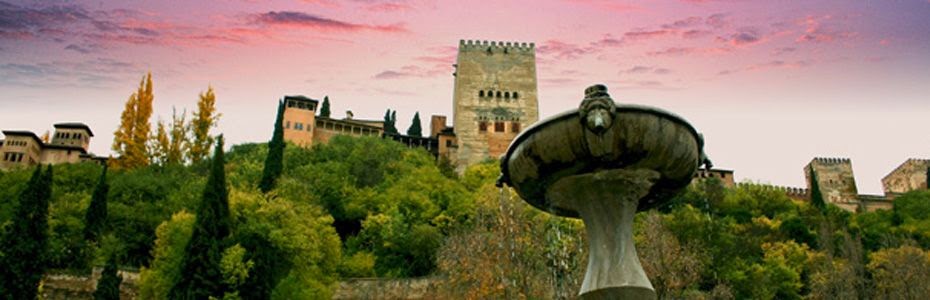





At night Sacromonte awakens with multiple, hole-in-the-wall Flamenco bars that truly come alive only when most of the city begins its nightly slumber. To experience Gitano culture in its most raw form, the Flamenco music, song and dance found in these clubs are often completely impromptu as various Flamenco singers, dancers and musicians put together a mosaic of sound and movement to the delight of their onlookers.

The history of the Sacromonte is significant in that its name is derived from the Sacromonte Abbey, which in many respects is central to Granada's transition from Moorish stronghold to its current Catholic identity. The abbey is said to be built over the catacombs of the bones of Saint Cecilio, the patron saint of Granada, and has been key in the propagation, whether fabricated or re-discovered, of the city's pious origins.
The legend states that the catacombs are the site of Saint Caecilius's martyrdom, and the abbey preserves Lead Books of Sacromonte.
The supposed relics of Caecilius and eleven other saints' bones, ashes and the oven in which they were believed to have been burned. It also possesses the inscribed lead plaques and books that were found with the supposed relics, but which were subsequently officially dismissed as forgeries.
 The Morisco population of Granada had been expelled to other parts of Spain following the Morisco Revolt
of 1568 (except for those few trusted Moriscos who had served in the
royal forces, and who were permitted to remain in the old Moorish
quarter of Albaicin adjacent to Valparaiso). By the 19th century, the
area had become home to a substantial Gitano community, who built their homes in caves excavated from the soft rock of the hillside. The area became famous for Flamenco
music and dancing, but major floods and forced evacuations in the 1960s
left the neighborhood population dramatically reduced. Since the early
1990s, however, the area has slowly become developed as a tourist
attraction, and as a centre of Gitano culture.
The Morisco population of Granada had been expelled to other parts of Spain following the Morisco Revolt
of 1568 (except for those few trusted Moriscos who had served in the
royal forces, and who were permitted to remain in the old Moorish
quarter of Albaicin adjacent to Valparaiso). By the 19th century, the
area had become home to a substantial Gitano community, who built their homes in caves excavated from the soft rock of the hillside. The area became famous for Flamenco
music and dancing, but major floods and forced evacuations in the 1960s
left the neighborhood population dramatically reduced. Since the early
1990s, however, the area has slowly become developed as a tourist
attraction, and as a centre of Gitano culture.
