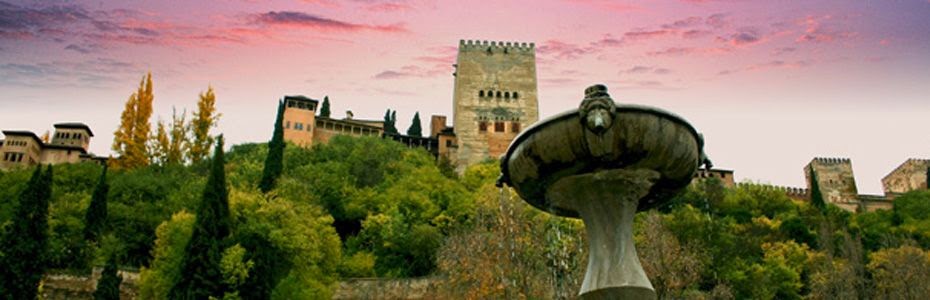

Must see places in Andalusia, Spain

If you are a muslim traveller or an islamic architecture lover those are the 7 things you must see in Granada

Top 10 foods to try in Morocco

One of the great cuisines of the world, Moroccan cooking abounds with subtle spices and intriguing flavour combinations.

Top Five Must See Things in Cordoba, Spain

Cordoba قرطبة in the Andalucia province of southern Spain is a city with more than 2,500 years of developed history.

ChefChaouen, the blue city in Morocco

Located just a few hours by bus from Tangier and far enough off the beaten track to dissuade many tourists, Chefchaouen is quiet enough for those visitors overwhelmed by the busy medinas of Fez and Marrakech, and has just enough of what is quintessentially Moroccan to be of interest to other travelers looking for something a bit more authentic.

Fes, Morocco

The most mystical of Morocco's imperial cities, Fez. Capital and spiritual center of Morocco, this city is situated in a narrow valley against the backdrop of the Middle Atlas

Mostrando entradas con la etiqueta Spain. Mostrar todas las entradas

viernes, 7 de agosto de 2015

The Aljafería Palace, قصر الجعفرية‎ Qasr al-Jaʿfariya in Zaragoza, Spain

The Aljafería Palace (Spanish: Palacio de la Aljafería; Arabic: قصر الجعفرية‎, tr. Qasr al-Jaʿfariya) is a fortified medieval Islamic palace built during the second half of the 11th century in the Moorish taifa of Zaragoza of Al-Andalus, present day Zaragoza, Spain.

It was the residence of the Banu Hud dynasty during the era of Abu Jaffar Al-Muqtadir after abolishing Banu Tujibi of Kindah dynasty. The palace reflects the splendor attained by the kingdom of the taifa of Zaragoza at the height of its grandeur. The palace currently contains the Cortes (regional parliament) of the autonomous community of Aragon.

The structure holds unique importance in that it is the only conserved testimony of a large building of Spanish Islamic architecture of the era of the Taifas (independent kingdoms).

History

 After the capture of Zaragoza in 1118 by Alfonso I of Aragon, the Aljafería became the residence of the Christian kings of the Kingdom of Aragon and as such was converted into the focal point for spread of the Mudéjar Architecture of Aragon. It was the birthplace of Saint Elizabeth of Portugal in the year 1271.

It was used as the royal residence by Peter IV of Aragon and subsequently, on the principal building site, a renovation was carried out that converted these chambers into the palace of the Catholic Monarchs in 1492. In 1593, the structure experienced another renovation that converted it into a military base, first according to Renaissance designs (which today can be observed in its moat and gardens) and later as military quarters.

The building suffered continuous alterations and considerable imperfections, above all with the Siege of Zaragoza during the Peninsular War until it was finally restored in the second half of the 20th century and currently it houses the Cortes or autonomous community legislative assembly of Aragon.

In the original construction, extra ramparts were made in the open field surrounding the Aljafería. With urban expansion over the years, the building has remained inside of the city. Yet the city of Zaragoza has not been able to honour the landscaped surroundings of the Aljafería. A freeway passes only a few meters away

 Troubadour Tower


The oldest construction of the Aljafería is called Troubadour Tower. The tower received this name from Antonio Garcia Gutierrez’s 1836 romantic drama The Troubadour. The drama was converted into a libretto for Giuseppe Verdi’s opera Il trovatore in 1853.

The tower is a defensive structure, with a quadrangular base and five levels which date back to the end of the 9th century AD, in the period governed by the first Banu Tujibi, Muhammad Alanqur, who was named after Muhammad I of Córdoba, independent Emir of Cordoba. According to Cabañero Subiza (1998) the Tower was built in the second half of the 10th century.[1] In its lower part, the tower contains vestiges of the beginning of the heavy walls of alabaster ashlar bond masonry, and continues upwards with plank lining of simple plaster and lime concrete, which is a thinner substance for reaching greater heights. The exterior does not reflect the division of the five internal floors and appears as an enormous prism, broken by narrow embrasures. Access to the interior was gained through a small door at such height that it was only possible to enter by means of a portable ladder. Its initial function was, by all indications, military.

The first level conserves the building structure of the 9th century and shelters two separated naves and six sections, which are separated by means of two cruciform pillars and divided by lowered horseshoe arcs. In spite of its simplicity, they form a balanced space and could be used as baths.

The second floor repeats the same spatial scheme as the previous floor, and the remains of Muslim brick-work from the 11th century can be seen in the brick façades, which indicates that the second floor was possibly reconstructed at the same time as the palace during the epoch of Al-Muqtadir.

martes, 16 de diciembre de 2014

Top Five Must See Things in Cordoba, Spain

Cordoba قرطبة in the Andalucia province of southern Spain is a city with more than 2,500 years of developed history. Established around the 8th century BC, Cordoba at one point was probably the world’s most populous city. Today, with only around 325,000 inhabitants, it’s actually one of the smaller cities in Spain but that doesn’t stop it being one of Spain’s most visited cities.
Cordoba is not only historic and beautiful, there are also so many things to see and do it’s often difficult to choose. If you are planning a first trip to Cordoba, or even a second or third one and haven’t seen every must see place on previous trips, there are five must see things everyone who visits Cordoba should see.

You can visit Cordoba in our Spain & Morocco Tour and Andalusia Routes

1. Great Mosque of Cordoba/Mezquita-Catedral 
 One of the most beautiful mosques in Spain, the Great Mosque of Cordova, or Mezquita-Catedral (Mosque Catheddral) is a World Heritage Site known for its stunning architecture. It is the world’s third largest mosque, although today it is used as a Roman Catholic church. Muslims in Spain have been lobbying the Spanish government since the year 2,000 to be allowed to pray in the mosque, but so far have been denied permission.
Construction on the mosque began in the year 785.

2. Alcazar
 The big attraction here are the gardens, laid out in descending terraces with typical Islamic rectangular pools - some of the most beautiful in Andalucia - perfect for a cooling waterside break on a hot spring day.


3. The Jewish Quarter "La Juderia"
The Jewish quarter of Cordoba goes back to the time of the Romans and consists of a network of narrow streets full of shops, restaurants and cafes, synagogues and museums. A must see is the Bullfight Museum and don’t miss the Zoco, where in the summer you can see flamenco dancers performing. You can visit too the 14th century synagogue and a restored Sefardi house. 


4. The Calahorra Tower and its "Al-Andalus living museum"
 The Al-Andalus living museum is located in an old Moorish fortress, and recreates the time of maximum splendour in this Andalusian city. The museum is in the Calahorra Tower, opposite the Great Mosque, at the end of the Roman Bridge. Its aim is to provide a recreation of the Cordoba of the period between the 9th-13th centuries.

5. ‎ Madīnat az-Zahrā  مدينة الزهراء 
 Medina Azahara (Arabic: مدينة الزهراءMadīnat az-Zahrā: literal meaning "city of the flower") is the ruins of a vast, fortified Arab Muslim medieval palace-city built by Abd-ar-Rahman III al-Nasir, (912–961) Umayyad Caliph of Córdoba, and located on the western outskirts of Córdoba, Spain. It was an Arab Muslim medieval town and the de facto capital of al-Andalus, or Muslim Spain, as the heart of the administration and government was within its walls. Built beginning in 936-940, the city included ceremonial reception halls, mosques, administrative and government offices, gardens, a mint, workshops, barracks, residences, and baths.

The Muslim Cordoba قرطبة

However, in the 8th century, something happened in Cordoba which was to radically change the course of history in the western world. A contingent of Arabic troops landed on the Mediterranean coast, and easily took over the weakened Visigoth kingdom. Cordoba was captured by Mugit, a deputy of Tariq, and Moslems settled in Cordoba side by side with their Christian counterparts. They lived in harmony, as is proved by the fact that the Moslems actually paid the Visigoths for the rights to move the musalla (the primitive prayer area outside the city walls) to the Visigoth basilica of San Vicente, thus forming the beginnings of the Great Mosque which still survives to this day.

The first rulers of the Islamic Qurtuba made it the administrative centre of their recently conquered lands. However, the fiercely tribal nature of the Arab and Berber peoples soon produced disputes between the rival factions struggling for power.

Abd al-Rahman I, known as "the Fugitive" or "the Dispossessed", united all the disaffected groups around the figure of the future Emir. In the year 756 these factions took over Cordoba and proclaimed it capital of the independent Emirate of Al-Andalus. Abd al-Rahman I carried out the first major enlargement of the Great Mosque of Cordoba and rebuilt the city walls and the Alcazar (castle). Hisham I, his son, finished off his father's work in the Great Mosque and built the first minaret, which has not survived. When Abd al-Rahman II came to power, the mosque was enlarged further and a lot of new building went on all over the city.

However, it was in the rule of Abd al-Rahman III when Cordoba really came into the limelight. In the  Medina Azahara outside the city walls, an endless source of legends due partly to the extravagantly expensive building materials used.

The arrival of the Omeyan year 929 Cordoba was proclaimed Capital of the independent Caliphate thus creating a schism with Damascus, and converting Cordoba into the religious, political and administrative centre of the entire Islamic kingdom in the west. One of the Caliph's first acts was to build the dazzling, but short-lived, royal residence of

The rule of Alhaken II, son of Abd al-Rahman III, heralded an era of stable government and the period of greatest cultural splendour in Cordoba. The Great Mosque was extended again, this time in the same majestic style as Medina Azahara

His successor, Hixam II, was only a puppet ruler, and left the task of government to his vizier Almanzor, who was responsible for the third and last major enlargement of the mosque.

The joint rule of Almanzor and Hixam weakened the kingdom, and the end was not far in sight. The Caliphate finally collapsed in 1013, and the city became one of the interim Taifa kingdoms.

viernes, 12 de diciembre de 2014

The Partal palace, one of the oldest areas of the Alhambra de Granada

The Partal is one of the oldest areas of the Alhambra and it was probably built by order of the Sultan Mohammad III (1302-1309). 

The name comes from an Arabic word meaning "the portico", and is the name given to the remains of the residence of Sultan Yusuf III, the northernmost of the Nasrid Palaces.

It was built following the same design as the ‘Palacio de Comares’: a rectangular court with a central ‘alberca’ and opposing edifices in the smaller sides.
The environment of the area suggests that it was the rest area of the Muslim nobility of the palace. They had a Muslim cemetery, “Rawda”, whose name was used to name the door “Rauda” that today is reduced to the foundations. 

Initially, this palace area was not attached to the Alhambra and when it passed to the control of the state, it was joined to the resort.


Although great original features have been lost, such as the residence of Yusuf III, demolished for the structural damages, the restoration is very similar to the past as the structure of the Partal, the tower de la dama or the pool.

In the 19th century, the Partal was in a very bad condition. It was restored by Torres Balbás. He followed a conservative style instead of the Romantic and decorative restorations that were usually done at that time in the Alhambra

The "Damas" Tower is the most important among the buildings of the magnates that lived around the Royal Palace in Arab times, and the decoration is the oldest of the Alhambra. This tower, in the eighteenth century, was called Torre del Principe, because here lived Fernando VI, son of Philip V, and was bought by the German Arthur Gwinner in 1886, and later it was transfered to the Spanish state in 1891, but not entirely. 

 Until the year 1924, when the tower's restoration was completed, it has gone through many alterations carried out by its inhabitants in order to live there 

Phothos by: objetivogranada.ideal.es Manu Rubio

jueves, 27 de noviembre de 2014

1609 The expulsion of Moriscos, the muslim andalusian people

In 1492, after 10 years of fighting, King Muhammad XII, known as Boabdil to the Spanish) surrendered the keys of the Alhambra Palace in Granada to Isabella of Castile and Ferdinand of Aragon.

The last King of Granada and the Catholic Monarchs had signed the Capitulation of Granada at the end of 1491, a treaty which guaranteed rights to Muslims, including religious tolerance and fair treatment, in return for their unconditional surrender.

However, the rights of the natives of Granada were not respected for long. New special taxes aimed at Muslims were introduced, they were forced to live in segregated districts, and Christians began settling on what had been Muslim-owned land

The Capitulation of Granada (extracts)


•    That both great and small should be perfectly secure in their persons, families, and property.
•    That they should be allowed to continue living in their dwellings and residences, whether in the city, the suburbs, or any other part of the country.
•    That their laws should be preserved, and that no-one should judge them except by those same laws.
•    That their mosques, and the religious endowments pertaining to them, should remain as they were in the times of Islam.
•    That no Christian should enter the house of a Muslim, or insult him in any way.
•    That all Muslim captives taken during the siege of Granada, from whatever part of the country they might have come, but especially the nobles and chiefs mentioned in the agreement, should be liberated.
•    That all those who might choose to cross over to Africa should be allowed to take their departure within a certain time, and be conveyed thither in the king's ships, and without any pecuniary tax being imposed on them.
•    That after the expiration of that time no Muslim should be hindered from departing, provided he paid, in addition to the price of his passage, the tithe of whatever property he might carry with him.
•    That the Christians who had embraced Islam should not be compelled to relinquish it and adopt their former creed.

Capitulation of Granada (selection)

•    That any Muslim wishing to become a Christian should be allowed some days to consider the step he was about to take; after which he is to be questioned by both a Muslim and a Christian judge concerning his intended change, and if, after this examination, he still refuses to return to Islam, he should be permitted to follow his own inclination.
•    That no Muslim should be prosecuted for the death of a Christian slain during the siege; and that no restitution of property taken during this war should be enforced.
•    That no increase should be made to the usual taxes, but that, on the contrary, all the oppressive taxes lately imposed should be immediately suppressed.
•    That no Christian should be allowed to peep over the wall, or into the house of a Muslim or enter a mosque.
•    That any Muslim choosing to travel or reside among the Christians should be perfectly secure in his person and property.
•    That no badge or distinctive mark be put upon them, as was done with the Jews and Mudejare (converted Muslims).
•    That no muezzin should be interrupted in the act of calling the people to prayer, and no Muslim molested either in the performance of his daily devotions or in the observance of his fast, or in any other religious ceremony; but that if a Christian should be found laughing at them he should be punished for it.
•    That the Muslims should be exempted from all taxation for a certain number of years.

The Capitulation of Granada

The Capitulation is a remarkable example of religious toleration for its time (or even for modern times). From the conquest in 1492 until 1495, both parties to the Capitulation tried to respect it. However, during the last years of the 15th century, several decrees were issued which over-ruled it. Muslims rights were unilaterally revoked. The arrival in Granada of the Archbishop of Toledo, the Franciscan Francisco Jiménez de Cisneros, in October of 1499, led to important changes in their situation.

Relying on Canon Law, the Cardinal held that Christians who had converted to Islam (called
‘helches’) or their descendants should be forced to return to Christianity.

Moreover, about 5000 Arabic manuscripts from the Madrassa were burned in the Bib-Rambla square in Granada on the orders of the Archbishop. Such actions broke with the policy of mutual respect and peaceful assimilation.

Changes in attitude

"[Archbishop of Toledo] helches have to be restored to our faith, because Canon Law demands that they be reconciled and returned to our faith"
Archbishop Cisneros, 1499


"Don Fernando and Doña Ysabel. To all magistrates and mayors of the Kingdom of Granada. You know that the Moors who lived in that Kingdom converted to our holy Catholic faith, but they had many false books of their false sect, which should be burned in the fire to destroy their memory and avoid them making mistakes. And We order to any person in possession of these books that within the established period they should give up the aforementioned books under pain of death and confiscation of their wealth if they do not respect this."
Provision of the Catholic Monarchs ordering the burning of all books in the Kingdom of Granada, 1501

Revolt in the Albaicin

These events caused a revolt in the Albaicin (the most famous Muslim quarter of Granada) and
triggered an irreversible process of conversion.

In 1502 the Muslim population of the former Kingdom of Granada was forced to convert or be expelled and, at the beginning of the 16th century, the conversion to Catholicism was declared compulsory within the Kingdom of Castile and the territories of the Crown of Aragon. All the Muslims who remained in Spain became Moriscos.

A threat to the Hispanic Monarchy

During the 1550s Turks and Berbers became a serious threat to Mediterranean Christian countries. Moriscos were seen as possible allies and were therefore regarded as a potential threat to the Hispanic Monarchy. A lot of propagandists, including representatives of the Church, proposed measures for dealing with the threat. Moriscos were officially Christians and therefore, according to the Canon Law, if they were proved to be heretics or apostates, they should be condemned to death.


“It is said that the Moors should incur the death penalty, the loss of their property and their children or risk servitude and slavery. It would not be an injustice if they were put to the sword, but at least His Majesty, in conscience and good government, must banish them from these Kingdoms.”
Fray Pedro Arias to the State Council


“If they go to Africa they will join up with the people from there and they will return to Spain. These people can be deported to the coasts of “macallaos” and Terranova, which are wide and without any population, where they should be castrated.”
Martín de Salvatierra,Bishop of Segorbe, 1587


“that all men, women and children were shut up in drilled vessels without oars, rudders, rigging and sails and sent to Africa.”
Report from Juan Boil de Arenós to the State Council, 1601


The expulsion of Moriscos

Finally, in 1609, Philip III decreed the expulsion of all Moriscos. The main argument for this was the

Although there had been rumours of expulsion for a long time, the news still took most Moriscos by surprise. They had to sell their possessions hurriedly and lots of them were robbed and killed during the journey.

The situation of Moorish children was also tragic. A lot of them were separated from their parents and the King established that fathers or mothers who refused to leave their sons and daughters should be executed. As a consequence of these measures, thousands of children were virtually kidnapped under the protection of the law.
possible support of the Moriscos for a supposed Turkish invasion of Spain. This decision especially affected the Crown of Aragon and, particularly, the former Kingdom of Valencia, where Moriscos formed one third of the total population.

Text by: http://www.historiana.eu

jueves, 20 de noviembre de 2014

Gharnati Music & Andalusian Nawbah... from Al-Andalus to the countries of the Maghreb

Andalusian Concert in Granada (Spain)
The Andalusian Classical Music in Morocco
  Morocco is home to Andalusian classical music that is found throughout North Africa. It probably evolved under the Moors in Cordoba, and the Persian-born musician Ziryab is usually credited with its invention.

Ziryab invented the Nawbah, a suite which forms the basis of al-âla, the primary form of Andalusian classical music today, along with Gharnati and Malhoun.

There used to be twenty-four Nawbah linked to each hour of the day, but only four Nawbah have survived in their entirety, and seven in fragmentary form. An entire Nawbah can last six or seven hours and are divided into five parts called mizan, each with a corresponding rhythm. The rhythms occur in the following order in a complete Nawbah:

- basît (6/4)
- qaum wa nusf (8/4)
- darj (4/4)
- btâyhi (8/4)

- quddâm (3/4 or 6/8)


Each mizan begins with instrumental preludes called either tuashia, m'shaliya or bughya, followed by as many as twenty songs (sana'a) in the entire mizan.

Andalusian classical schools are spread across Morocco, having left Spain when Muslims and Jews were driven out of the country. Valencia's school is now in Fez, while Granada's is located in Tetouan and Chefchaouen. Cities like Tangier and Meknes have their own orchestras as well.

Jews in Morocco played an important role in the perpetuation of this oral tradition. In fact, the late Rabbi David Bouzaglo was known to have a conservatory of sorts in Casablanca where a number of Arab and Jewish musicians trained in al-Ala.

Andalusian classical music uses instruments including Oud (lute), Rabab (fiddle), Darbouka (goblet drums), taarija (tambourine), Qanoon (zither) and kamenjah (violin). Other instruments have included pianos, banjos and clarinets, though none of these instruments lasted for long.

Andalusian classical music orchestras are spread across the country, including the cities of Fez, Tetouan, Chaouen, Tangier, Meknes, Rabat and Casablanca.


Andalusian Nawbah

Andalusi nubah (أندلسي نوبة) is a genre found in the North African Maghrib states of Morocco, Algeria, Tunisia, and Libya but, as the name indicates, of Spanish origin. The name replaced the older use of sawt and originates from the musician waiting behind a curtain to be told it was his turn or nawbah by the sattar or curtain man (Touma 1996, p. 68).


Lyrics are sung by the soloist or in unison by the chorus are chosen from the muwashshah or zajal poetic forms, being in classical and colloquial Arabic, respectively. (ibid, pp. 70-71).

Andalusi nubah uses one tab' (similar to maqam) per performance, and includes several instrumental pieces and predominantly vocal pieces accompanied by instrumentation. These differ as to mizan or rhythmic pattern (wazn) (ibid, p. 68).

 Gharnati

Gharnati is found in both Morocco and Algeria, primarily popular in Rabat and Oujda in Morocco. It is arranged in nuba like al-âla; there are four unfinished nuba and twelve complete ones. Orchestras consist of kvîtra, mandolin, banjo, oud and kamenjah. The word "Gharnati" comes from the Andalusian city of Granada.
 

Gharnati refers to a variety of Moroccan music originating in Andalusia. Its name is related, being derived from the Arabic name of the Spanish city of Granada.


Concert in Granada of Dar Gharnatia, Andalusian music group from Tlemcen (Algeria)

Gharnati constitutes the musical mode most used in the Moroccan city of Oujda, where besides this musical kind is omnipresent and where one organizes each year in June the International Festival of the Gharnati music. This musical art was preserved mainly at Tlemcen in Algeria and Oujda, near the Algerian border.

jueves, 13 de noviembre de 2014

The Corral del Carbon, one of the oldest arab monuments in Granada

Located in Calle Mariana Pineda, in the heart of Granada, Corral del Carbon is the oldest monument left us by the Arabs. 

The "Corral del Carbón", formerly called "Alhóndiga Gigida" was constructed in the early 14th century 
by Yusuf I and was used as a type of warehouse for merchandise and also as a shelter for merchants.

It is of special interest because it is the only remaining Moorish caravansara or fundak that still remains as it was in Spain.


The building has a quadrangular shape, with an entrance pavilion which has a large horseshoe arch that gives access to the vestibule which is covered with a cupola embellished with "muqarnas" (decorative motif characteristic of the Muslim architecture, based on vertically juxtaposed bows or prisms). Above the entrance door there is a small twin window. From here we enter the "'ostowan" or waiting vestibule with arches on its sides, that leads to the courtyard surrounded by galleries that open onto the three floors of the building. At the center of the courtyard we find a stone made fountain with two spouts.

The yard is laid out in typical Islamic design, with a symetrical courtyard, mosaic floorings, and a central water trough, which is the original drinking trough.

The paving of black and white stones indicates that this is a prosperous area, with the function of keeping down the dust from the floor. The black stones were gathered from the River Genil and the white from the River Darro

There is a government run craft/ Art shop housed in one of the buildings surrounding the courtyard, these were originally stables, used to house the mules of the merchants.

The upper galleried rooms were originally used by the merchants for making buisness deals, socialising and sleeping.

In Christian times it was used as an accommodation for coal merchants, from where it gets its name. Later, it became a playhouse for comedies, and finally, a neighbourhood until 1933 when the State acquired it and the architect "Leopoldo Torres Balbás" restored it.

martes, 11 de noviembre de 2014

Travel the halal way and discover The Alpujarras, Granada

Granada, Spain is an extraordinary city that invites travelers to explore its rich heritage and scenic attractions. Just south of the city, huddled on the southern hillside of the vast Sierra Nevada Mountain Range, sits the much lesser known magical and charming region of the Alpujarra.

Some fifty villages of varying sizes and common cultural features make up this historic area that spills over both the provinces of Granada and Almería. The villages also share a common topography; they perch along the slopes of two dramatic ravines that extend from the peaks of the Sierra Nevada and cut southeastward to form the basins of the Guadalfeo and the Andaraz Rivers.

The name for this region may come from the Arabic al-buqscharra, which could be translated as “the land of the pastures” given the abundance of water found in this fertile zone. The area is not easy to reach; the steep mountainside landscape has obliged villagers to build a network of terraces and ditches to optimize irrigation. The hilly geography does not facilitate the use of machinery for carrying out agricultural work. While this has posed a historical challenge to agriculturists, it has helped preserve a natural aura that offers observers a peek into a distant age that appears lost in time.

After the fall of the Nasrid Kingdom of Granada in 1492, the Andalusia Muslims were required by law to convert to Catholicism under the Catholic monarchs after 1502. Muslims who refused to leave their Andalusia homes to go to Northern Africa were known as Moriscos.

They remained in this area until 1568, when the Morisco revolt lead by Abén Humeya (whose Christian name of Fernando de Válor) was violently defeated a year later by the Spanish king’s army. After the Castilian victory, by order of the crown, two Morisco families were permitted to continue living in each town to teach new Christian settlers from Castile, Leon, and Galicia how to work the challenging terraced land and maintain the irrigation system so vital to the local agriculture. Unfortunately, the plan proved unsuccessful, and the traditional farming systems were lost in favor of methods adopted from the central and northern regions of the peninsula.


The influence of Northern Africa has been maintained in the region’s architecture, clearly related to the Berbers, with homes that appear stacked or overlapping to form passageway-tunnels called “tinaos”. Houses also have flat roofs called launa, which are covered with gravel, affording residents rooftop terrace spaces. There are no tiles here, and the home’s design takes advantage of every square meter, each one playing a necessary and functional role. Other Northern African elements that have been maintained in the Alpujarra include many cooking traditions, the use of jarapas (carpets made of recycled fabric), and the area’s place names such as Alcolea, Bentarique, La Taha, Ohanes…

Jarapa, traditional carpet from the Alpujarras
The most common way to visit the area is through the town of Lanjarón, one of the Alpujarra’s entry points along with Órgiva. Beyond this spa-town (famous throughout Spain for its mineral water), visitors follow winding mountain roads to cross the historic Tablate Bridge, the scene of the last great battle between Christian soldiers and Alpujarra Moriscos, the confrontation which ended the so-called “Morisco rebellion” in the third quarter of the 16th century.


A few kilometers past the bridge and around a tight curve, the scenic Poqueira River gorge offers fantastic views. The gorge is home to three towns: Capileria, bubión, and Pampaneira, names that may sound Gaelic but which are Arab in origin.

Visitors continuing on their journey may reach Trevélez, peninsular Spain’s highest town, a place famous for its hams. Hams here are cured in the cold, dry air of the Sierra Mountains, which is where the name jamón serrano comes from.


It is not surprising that this region has left an indelible impression on many observers, such as the Granada writer Pedro Antonio de Alarcón, who in 1874 published the book La Alpujarra about this area of the Sierra Nevada Mountains. In 1957, British writer Gerald Brenan published South from Granada, a story that takes place in the Alpujarra town of Yegen and which was made into a movie in 2003 by Fernando Colomo. The former drummer for the music group Genesis, Chris Stewart, who is a resident in the local mountain town of Órgiva, has recently published two enjoyable novels. They narrate the adventures of a cosmopolitan Englishman who decides to move to the seclusion of these mountains with his wife and daughter. Driving Over Lemons: An Optimist in Andalucia and A Parrot In the Pepper Tree are both highly recommendable titles.


The scenic mountain atmosphere of the Alpujarra and its charming villages make for enjoyable and memorable travel experiences. This is a recommended trip for anyone visiting Spain and a must for those going to Granada.

Text by: donquijote.org http://www.donquijote.org/culture/spain/places/cities/la-alpujarra 
Photos by: Vive Alpujarra Proyecto https://www.facebook.com/Vive.Alpujarra

martes, 4 de noviembre de 2014

Travel the halal way and discover.... the Sagrada Familia in Barcelona!

The Sagrada Família, Antoni Gaudí's unfinished masterpiece, is one of Barcelona's most popular
tourist attractions. Construction on this church will continue for at least another decade, but it has already become Barcelona's most important landmark.

A New Church

The idea for the construction of a new church was launched by a devout organisation whose goal was to bring an end to the de-christianisation of the Barcelonese, which had started with the industrialization and was caused by the increasing level of education of the Catalan population. 

The organisation purchased a plot of land in the new Eixample district in 1877. The architect Francisco de Paula del Villar designed a neo-Gothic church and led the construction which started in 1882.


Antoni Gaudí's Design

 One year later, the modernist architect Antoni Gaudí took over as lead architect at the age of thirty-one. From that moment on, Gaudí devoted most of his life to the construction of the church.

Instead of sticking to the original plans, Gaudí changed the design drastically. The neo-Gothic style made way for Gaudí's trademark modernist style, which was based on forms found in nature. When he died in 1926 only one facade (the Nativity Facade), one tower, the apse and the crypt were finished.

Because Gaudí was constantly improvising and changing the design while construction was going on, he left few designs and models. And most of these were destroyed in 1936 during the Civil War. 

Eighteen Towers

Still, architects now have a clear idea of what Gaudí had in mind. The last version of his design called for a church 95m/312ft long and 60m/197ft wide. The church will be able to accommodate some thirteen thousand people. When finished, the Sagrada Família will have a total of eighteen towers.

Four towers on each of the three facades represent the twelve apostles. The towers reach a height of 90 to 120 meters (394ft). Another four towers represent the four evangelists. They will surround the largest, 170m/558ft tall tower, dedicated to Jesus Christ. The last tower, dedicated to Virgin Mary, will be built over the apse.

Construction

After Gaudí's death in 1926 construction slowed dramatically due to a lack of funds and the outbreak of the Civil War.

Construction pace started to pick up again in the mid 1950s and now two facades and eight towers have been completed. The main nave was roofed in 2000. At that time construction was expected to last for another hundred years, but modern technology has enabled architects to speed up construction so that the Sagrada Família is now slated for completion in 2026, the centenary of Gaudí's death. 

Facades

The first facade, facing east, is known as the Nativity Facade. It was finished by Gaudí himself and is
ornamented in a Baroque fashion with motifs of animals and plants.

Nativity Facade
Opposite the Nativity Facade is the Passion Facade. Construction started in 1954, but only in 1987 sculptures depicting the crucified Jesus Christ were added. As soon as they were installed, the abstract figures caused a storm of criticism, as the style was very different from Gaudí's.

The third and main facade is the Glory Facade. Construction of this facade - the most monumental of the three - started in 2002 and is still ongoing. This facade, on the south side of the church, will picture life and death. 

Visiting Sagrada Família

Interior Sagrada Familia
Even though the Sagrada Família is far from finished, the remarkable church is well worth a visit. You can visit the crypt were Gaudí is buried as well as the transept and central nave with its giant, tree-like pillars and spectacular vaulting. A museum narrates the history of the church and tells the story of its great architect.

You can also visit the towers. An elevator and a long walk will lead you to the top of a tower from where you have a magnificent view over Barcelona. The climb is not recommended for those with fear of heights or for people with claustrophobia!

Send us a request trip and add this excusion in Barcelona to your travel 


lunes, 3 de noviembre de 2014

Travel the halal way and discover.... Casa Batlló in Barcelona!

The colour and fantasy of the Casa Batlló captivates passers-by on the Passeig de Gràcia (Barcelona). Standing halfway up this elegant boulevard and in a strongly contrasting style to the neighbouring houses, the Casa Amatller and Casa Lleó Morera, Gaudí’s building reveals the splendour of an architect who was able to work on this project with total creative freedom, Antoni Gaudí.

The architect Antoni Gaudí undertook a radical refurbishment of a building in Barcelona’s Passeig de Gràcia dating from 1875 to create one of his boldest works. 


Gaudí’s imaginative efforts were key to the development of the project, as was the decorative work of the artisans who collaborated with him between 1904 and 1906. A simple glance gives rise to myriad interpretations.


The discs of multicoloured glazed-ceramics and broken shards of stained glass, placed with precision, depict flowers and water lilies and play with the reflections of the sunlight. This vast impressionist painting is often interpreted as the surface of the rolling sea in the heart of Passeig de Gràcia.

On the first floor of the Casa Batlló, a long sandstone balcony allows us to look inside the elegant mezzanine, while the other floors have balconies in the shape of masks. And at the top, a scaly ceramic skin and turret crowned by a four-armed cross remind us of the legend of Saint George. Inside the Casa Batlló, you can visit the mezzanine, see the ceramic skylight, the double attic space with its sequence of catenary arches, and the rooftop with its colourful mosaiced chimneys. An explosion of creative freedom where Gaudí spared no effort in creating a functional and modern house.

  
Add this excursion sending your request trip to Alhamratour 

viernes, 31 de octubre de 2014

Travel the halal way and discover.... Park Güell in Barcelona!

Park Güell was an attempt to create a housing estate in a natural setting in the old village of Gràcia: an ambitious property development project commissioned by Gaudí’s patron, Eusebi Güell. 

The architect chose an uneven site covering a surface area of 15 hectares where 40 detached houses were to be built. Only two were actually completed, and Gaudí lived in one of them.


It is now a museum devoted to the architect’s life and work. Gaudí prepared the site of Park Güell between 1900 and 1914, showcasing his urban-planning concerns by building paths, arcades and viaducts that were fully integrated into Barcelona’s natural surroundings.

Gaudí’s characteristic vivid imagination is revealed in the different elements that amaze visitors from around the world that visit 
Barcelona. The gatehouses, which were originally designed as the caretaker’s house, are now home to the Park Güell Interpretation Centre. 

The flight of steps, with its famous dragon covered in coloured broken-ceramic pieces, leads to the hypostyle hall, an impressive space comprising 86 columns which underpins the plaza above. The curving bench around the perimeter of the plaza was designed by Jujol, one of Gaudí’s associates in the construction of this unique park in the old village of Gràcia which has been declared a World Heritage Site

viernes, 17 de octubre de 2014

Ishbiliya إشبيلية, the muslim Seville

You can visit this city in our tour Spain & Morocco of  10days / nights

The Islamic kingdoms of medieval Spain are legendary for their artistic and architectural glories. They are also famous, although perhaps at times through rose-tinted spectacles, for centuries of co-existence between Muslims, Jews and Christians, and for the flowering of a rich culture which drew on the best of the Religions of the Book.

Nowadays, the best-known (and most visited) of the cities of these medieval kingdoms are Granada, home to the Alhambra palace, and Cordoba, site of the breathtaking Mezquita mosque with its forest of red and white arches.

But Seville, now a sprawling modern city, also deserves recognition for its Islamic-influenced cultural heritage.
Torre del Oro and Guadalquivir River
Seville was founded as the Roman city of Hispalis, and was known as Ishbiliya (Arabic:إشبيلية) after the Muslim conquest in 712.

During the Muslim rule in Spain, Seville came under the jurisdiction of the Caliphate of Córdoba before becoming the independent Taifa of Seville; later it was ruled by the Muslim Almoravids and the Almohads until finally being incorporated into the Christian Kingdom of Castile under Ferdinand III in 1248

The Moorish urban influences continued and are present in contemporary Seville, for instance in the custom of decorating with herbaje and small fountains the courtyards of the houses. However, most buildings of the Moorish aesthetic actually belong to the Mudéjar style of Islamic art, developed under Christian rule and inspired by the Arabic style. Original Moorish buildings are the Patio del Yeso in the Alcázar, the city walls, and the main section of the Giralda, bell tower of the Seville Cathedral.[8]


Centuries of Islamic Architecture


The most prominent remnant of Seville's Islamic past is La Giralda, the towering minaret of a 12th century Almohad mosque, which became the city's Catholic cathedral after its conquest by Saint Ferdinand in 1248. At 320 feet high, La Giralda was once the tallest tower in the world. Modeled on the minaret of the Kutubiyya mosque in Marrakech, it has a sister in the Hassan Tower at an uncompleted mosque in Rabat.

La Giralda, the towering minaret of a 12 th century Almohad mosque
The modern-day cathedral was begun in the late 14th century, after the Great Mosque was pulled down, but it still holds the tomb of Saint Ferdinand. The tomb's inscriptions celebrate Ferdinand's achievements not only in Castilian and the monastic language of medieval Christianity, Latin, but also in Hebrew and Arabic. And Ferdinand's son, Alfonso, tried to make Seville a centre for Arabic scholarship and translation, losing out to the long-established academia of Toledo


Floodlit at Night


La Giralda's golden stone glows softly, towering over the busy nightlife of the old quarter of Seville whose narrow streets remind visitors of their original character as the city's souk. In the square around the foot of the tower are citrus trees, bearing the Seville oranges famous the world over.

Alcázar of Seville
Just seconds' walk away – close enough for first Muslim and then Christian kings to reach their place of worship through a private tunnel – is the site which has been home to several generations of royal palaces, of the Almohad dynasty and the later Christian kings.


The present occupant of the site is the spectacular Alcazar palace; its name is a corruption of the Arabic al qasr. Its ornate plasterwork – which incorporates repeated Arabic scripts, including the phrase Wa la ghalib ill Allah – "There is no victor but Allah" - is a reflection of the splendors of the Alhambra in Granada, and its tile work also draws heavily on Muslim Andalucian designs. No casual visitor, wandering the Alcazar's courtyards, would be likely to guess that it was commissioned by a Christian monarch.

But the palace – although built around structures which may date as far back as the Umayyad period of the 10th and early 11th centuries, when their Caliphate centered on Cordoba - was completed by workmen who had spent several generations building Granada's Alhambra, and who were then lured west by the Christian king Pedro the Cruel.

Ibn Khaldun, the great philosopher of history, whose distant ancestors hailed from Seville before they fled the Almoravid conquest of the city in the 11th century, visited Seville during his travels around Andalucia in 1364-5, when the ornate plasterwork of the Alcazar was only just dry. Pedro the Cruel tried to persuade him to stay, offering him his family's historical lands, as well as high office – but his interest in the one remaining Muslim kingdom in Spain, Granada, won out.

The Andalucian Melting-Pot  

The Alcazar's cultural, artistic and religious mixture epitomizes the blurring of religious and cultural lines in Andalucia, where Muslims, Christians and Jews lived and worked alongside each other and where Muslim and Christian armies often fought alongside one another against rival small kingdoms, or taifas.

One of the most famous figures of the period was El Cid (a corruption of the Arabic sayyid, 'lord'), described by writer Maria Rosa Menocal as “this Christian warrior with the Arabic name [who] was leading troops into battles between one Muslim and another,” who fought for the King of Seville in late 11th century battles against Granada. He became the hero of a great epic poem in medieval Spanish, and finally of a Hollywood movie.

Another was Samuel the Nagid, the Jewish vizier of Granada, who helped maintain his city's military strength under the Berber King Habbus al-Muzaffar in the 11th century, and who conquered Seville in 1039 for Habbus' son Badis.

For centuries this patchwork of Muslim and Christian kingdoms, with their shifting alliances, fostered a vibrant artistic life. It did not, perhaps, rival the scale of the Madinat as-Zahra in Cordoba, built by Abd ar-Rahman III at the height of the Caliphate and lost for a millennium after it was sacked in the civil war that brought down the Umayyads in Spain. But its creations do include the Alhambra in Granada, the Alcazares of Seville and of Segovia and Carmona, and the fashion for Mudejar craftsmanship lived on even after the Christian conquest of Spain was completed in 1492, with noble palaces commissioned in this style for decades to come.

According to Professor Maria Luise Fernandez, of Caracas University, the strength of Islamic artistic traditions even carried it to the Americas. Mudejar designs can, she says, be found in Spanish colonial architecture in cities such as Mexico City, Quito and Caracas, and in the 'azulejo' style of blue tilework – from al-zulaij, colloquial Arabic for ornamental tiles – which became associated with towns such as Puebla in Mexico.

Poet-Kings and Philosophers

But the glories of Seville's Muslim past are not only in its visual architecture.
In her book on the centuries of Muslim kingdoms which made up medieval Andalucia, Ornament of the World: how Muslims, Jews & Christians created a culture of tolerance in Medieval Spain, Menocal refers to 11th century Seville as “the poetry-mad Abbadid taifa of Seville.” The rivalry between Seville and the neighboring taifa of Toledo was, says Menocal, as much about the cities' cultural profile as their military strength.

“Military and cultural ambitions were purposefully intertwined and their Seville became the new haven for poetry in al-Andalus,” continues Menocal. “The Abbadid-sponsored academy of poets played all sorts of important roles in poetic history, attracting poets from inside and outside the peninsula and leaving us an important diwan, or anthology, of the poetry of the period.”
Mutamid Ibn Abbad, the last king of the Abbadid dynasty, was not only a great patron of the arts, but is considered one of the greatest Andalusian poets in his own right. Andalucian poetry spanned topics from romantic love to political satire, and al-Mutamid's own work ranged from praises of his wife:
"Invisible to my eyes, thou art ever present to my heart. Thy happiness I desire to be infinite, as are my sighs, my tears, and my sleepless nights! Impatient of the bridle when other women seek to guide me, thou makest me submissive to thy lightest wishes" [The Poems of Mu'Tamid, King of Seville, translated DL Smith, 1915]

And to celebration of his own military victories:

“I have won at the first onset The hand of the lovely C?rdoba; That brave Amazon who with sword and spear Repelled all those who sought her in marriage. And now we celebrate our nuptial in her palace, While the other monarchs, my baffled rivals, Weep tears of rage and tremble with fear.” [The Poems of Mu'Tamid, King of Seville, translated DL Smith, 1915]

A monument to Seville's “poet-king” and his “sad overthrow” by the Berber Almoravids, who he had supported against Christian rivals in the naïve belief that he could then expel them from his own lands, is still to be found in the grounds of the Alcazar.