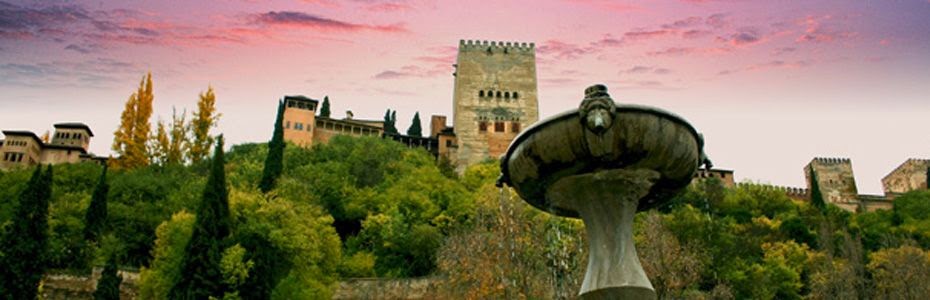

Must see places in Andalusia, Spain

If you are a muslim traveller or an islamic architecture lover those are the 7 things you must see in Granada

Top 10 foods to try in Morocco

One of the great cuisines of the world, Moroccan cooking abounds with subtle spices and intriguing flavour combinations.

Top Five Must See Things in Cordoba, Spain

Cordoba قرطبة in the Andalucia province of southern Spain is a city with more than 2,500 years of developed history.

ChefChaouen, the blue city in Morocco

Located just a few hours by bus from Tangier and far enough off the beaten track to dissuade many tourists, Chefchaouen is quiet enough for those visitors overwhelmed by the busy medinas of Fez and Marrakech, and has just enough of what is quintessentially Moroccan to be of interest to other travelers looking for something a bit more authentic.

Fes, Morocco

The most mystical of Morocco's imperial cities, Fez. Capital and spiritual center of Morocco, this city is situated in a narrow valley against the backdrop of the Middle Atlas

Mostrando entradas con la etiqueta europe. Mostrar todas las entradas

viernes, 23 de enero de 2015

Travel the Halal Way & Discover Italy in this 6 days/5 nights Tour


1ST DAY – ARRIVAL TO MILAN

Arrival to Milan Fiumicino Airport. Transfer to the hote for early check-in. Breakfast provided. Evening free and easy Dinner at the hotel. Overnight in Milan.


2ND DAY – MILAN

Full day visiting Milan. The visit includes Victor Manuel II gallery, Piazza della Scala, the Cathedral, etc.

Lunch at a halal local restaurant.Dinner at local halal restaurant.

Overnight in Milan


3RD DAY – MILAN TO ROME (3 HOURS)

Full morning at Fidenza Village for your shopping. Then transfer to Milan's train station for your fast train to Rome.

Check-in at the hotel upon arrival and free evening.

Dinner at the hotel and overnight in Rome.


4TH DAY – ROME

Full day visiting Rome. The visit includes Coliseum, St Peters Basilica, Spanish Steps and the Grand Mosque of Rome. Lunch will be conducted in a halal local restaurant.

Dinner at local restaurant and overnight in Rome.


5TH DAY – ROME

Morning free and easy at your own leisure. Car disposal and guide with you.

In the afternoon, transfer to Castel Romano Shopping Village for your shopping experience.

Dinner at local restaurant and overnight in Rome.

6TH DAY – DEPARTURE FROM ROME

Morning free and easy before your transfer to the airport. Early lunch provided.

End of the services.
 

lunes, 22 de diciembre de 2014

De l'Espagne au Portugal l'héritage d'Al Andalus

Pendant près de sept siècles, Al-Andalus a formé un foyer culturel incontournable de l'Europe médiévale. Nourries des traditions chrétiennes, juives et musulmanes, ces terres portent une histoire riche, que Patrick de Carolis invite à découvrir. De Cordoue à Grenade, en passant par Evora, Mértola, Tolède, Jerez de la Frontera, ou encore Séville, ce voyage permet de plonger au coeur de l'histoire de la péninsule ibérique. 


martes, 4 de noviembre de 2014

Travel the halal way and discover.... the Sagrada Familia in Barcelona!

The Sagrada Família, Antoni Gaudí's unfinished masterpiece, is one of Barcelona's most popular
tourist attractions. Construction on this church will continue for at least another decade, but it has already become Barcelona's most important landmark.

A New Church

The idea for the construction of a new church was launched by a devout organisation whose goal was to bring an end to the de-christianisation of the Barcelonese, which had started with the industrialization and was caused by the increasing level of education of the Catalan population. 

The organisation purchased a plot of land in the new Eixample district in 1877. The architect Francisco de Paula del Villar designed a neo-Gothic church and led the construction which started in 1882.


Antoni Gaudí's Design

 One year later, the modernist architect Antoni Gaudí took over as lead architect at the age of thirty-one. From that moment on, Gaudí devoted most of his life to the construction of the church.

Instead of sticking to the original plans, Gaudí changed the design drastically. The neo-Gothic style made way for Gaudí's trademark modernist style, which was based on forms found in nature. When he died in 1926 only one facade (the Nativity Facade), one tower, the apse and the crypt were finished.

Because Gaudí was constantly improvising and changing the design while construction was going on, he left few designs and models. And most of these were destroyed in 1936 during the Civil War. 

Eighteen Towers

Still, architects now have a clear idea of what Gaudí had in mind. The last version of his design called for a church 95m/312ft long and 60m/197ft wide. The church will be able to accommodate some thirteen thousand people. When finished, the Sagrada Família will have a total of eighteen towers.

Four towers on each of the three facades represent the twelve apostles. The towers reach a height of 90 to 120 meters (394ft). Another four towers represent the four evangelists. They will surround the largest, 170m/558ft tall tower, dedicated to Jesus Christ. The last tower, dedicated to Virgin Mary, will be built over the apse.

Construction

After Gaudí's death in 1926 construction slowed dramatically due to a lack of funds and the outbreak of the Civil War.

Construction pace started to pick up again in the mid 1950s and now two facades and eight towers have been completed. The main nave was roofed in 2000. At that time construction was expected to last for another hundred years, but modern technology has enabled architects to speed up construction so that the Sagrada Família is now slated for completion in 2026, the centenary of Gaudí's death. 

Facades

The first facade, facing east, is known as the Nativity Facade. It was finished by Gaudí himself and is
ornamented in a Baroque fashion with motifs of animals and plants.

Nativity Facade
Opposite the Nativity Facade is the Passion Facade. Construction started in 1954, but only in 1987 sculptures depicting the crucified Jesus Christ were added. As soon as they were installed, the abstract figures caused a storm of criticism, as the style was very different from Gaudí's.

The third and main facade is the Glory Facade. Construction of this facade - the most monumental of the three - started in 2002 and is still ongoing. This facade, on the south side of the church, will picture life and death. 

Visiting Sagrada Família

Interior Sagrada Familia
Even though the Sagrada Família is far from finished, the remarkable church is well worth a visit. You can visit the crypt were Gaudí is buried as well as the transept and central nave with its giant, tree-like pillars and spectacular vaulting. A museum narrates the history of the church and tells the story of its great architect.

You can also visit the towers. An elevator and a long walk will lead you to the top of a tower from where you have a magnificent view over Barcelona. The climb is not recommended for those with fear of heights or for people with claustrophobia!

Send us a request trip and add this excusion in Barcelona to your travel 


lunes, 3 de noviembre de 2014

Travel the halal way and discover.... Casa Batlló in Barcelona!

The colour and fantasy of the Casa Batlló captivates passers-by on the Passeig de Gràcia (Barcelona). Standing halfway up this elegant boulevard and in a strongly contrasting style to the neighbouring houses, the Casa Amatller and Casa Lleó Morera, Gaudí’s building reveals the splendour of an architect who was able to work on this project with total creative freedom, Antoni Gaudí.

The architect Antoni Gaudí undertook a radical refurbishment of a building in Barcelona’s Passeig de Gràcia dating from 1875 to create one of his boldest works. 


Gaudí’s imaginative efforts were key to the development of the project, as was the decorative work of the artisans who collaborated with him between 1904 and 1906. A simple glance gives rise to myriad interpretations.


The discs of multicoloured glazed-ceramics and broken shards of stained glass, placed with precision, depict flowers and water lilies and play with the reflections of the sunlight. This vast impressionist painting is often interpreted as the surface of the rolling sea in the heart of Passeig de Gràcia.

On the first floor of the Casa Batlló, a long sandstone balcony allows us to look inside the elegant mezzanine, while the other floors have balconies in the shape of masks. And at the top, a scaly ceramic skin and turret crowned by a four-armed cross remind us of the legend of Saint George. Inside the Casa Batlló, you can visit the mezzanine, see the ceramic skylight, the double attic space with its sequence of catenary arches, and the rooftop with its colourful mosaiced chimneys. An explosion of creative freedom where Gaudí spared no effort in creating a functional and modern house.

  
Add this excursion sending your request trip to Alhamratour