
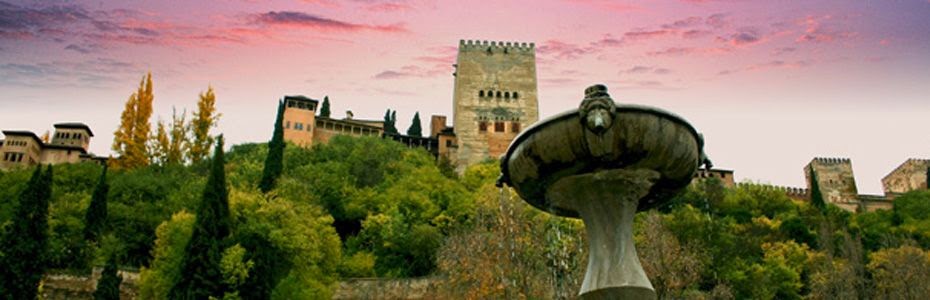





 In 1492, after 10 years of fighting, King Muhammad XII, known as Boabdil to the Spanish) surrendered the keys of the Alhambra Palace in Granada to Isabella of Castile and Ferdinand of Aragon.
 The last King of Granada and the Catholic Monarchs had signed the Capitulation of Granada at the end of 1491, a treaty which guaranteed rights to Muslims, including religious tolerance and fair treatment, in return for their unconditional surrender.
However, the rights of the natives of Granada were not respected for long. New special taxes aimed at Muslims were introduced, they were forced to live in segregated districts, and Christians began settling on what had been Muslim-owned land
The Capitulation of Granada (extracts)

• That both great and small should be perfectly secure in their persons, families, and property.
• That they should be allowed to continue living in their dwellings and residences, whether in the city, the suburbs, or any other part of the country.
• That their laws should be preserved, and that no-one should judge them except by those same laws.
• That their mosques, and the religious endowments pertaining to them, should remain as they were in the times of Islam.
• That no Christian should enter the house of a Muslim, or insult him in any way.
• That all Muslim captives taken during the siege of Granada, from whatever part of the country they might have come, but especially the nobles and chiefs mentioned in the agreement, should be liberated.
• That all those who might choose to cross over to Africa should be allowed to take their departure within a certain time, and be conveyed thither in the king's ships, and without any pecuniary tax being imposed on them.
• That after the expiration of that time no Muslim should be hindered from departing, provided he paid, in addition to the price of his passage, the tithe of whatever property he might carry with him.
• That the Christians who had embraced Islam should not be compelled to relinquish it and adopt their former creed.
Capitulation of Granada (selection)
• That any Muslim wishing to become a Christian should be allowed some days to consider the step he was about to take; after which he is to be questioned by both a Muslim and a Christian judge concerning his intended change, and if, after this examination, he still refuses to return to Islam, he should be permitted to follow his own inclination.• That no Muslim should be prosecuted for the death of a Christian slain during the siege; and that no restitution of property taken during this war should be enforced.
• That no increase should be made to the usual taxes, but that, on the contrary, all the oppressive taxes lately imposed should be immediately suppressed.
• That no Christian should be allowed to peep over the wall, or into the house of a Muslim or enter a mosque.
• That any Muslim choosing to travel or reside among the Christians should be perfectly secure in his person and property.
• That no badge or distinctive mark be put upon them, as was done with the Jews and Mudejare (converted Muslims).
• That no muezzin should be interrupted in the act of calling the people to prayer, and no Muslim molested either in the performance of his daily devotions or in the observance of his fast, or in any other religious ceremony; but that if a Christian should be found laughing at them he should be punished for it.
• That the Muslims should be exempted from all taxation for a certain number of years.
The Capitulation of Granada
The Capitulation is a remarkable example of religious toleration for its time (or even for modern times). From the conquest in 1492 until 1495, both parties to the Capitulation tried to respect it. However, during the last years of the 15th century, several decrees were issued which over-ruled it. Muslims rights were unilaterally revoked. The arrival in Granada of the Archbishop of Toledo, the Franciscan Francisco Jiménez de Cisneros, in October of 1499, led to important changes in their situation.Relying on Canon Law, the Cardinal held that Christians who had converted to Islam (called
‘helches’) or their descendants should be forced to return to Christianity.
Moreover, about 5000 Arabic manuscripts from the Madrassa were burned in the Bib-Rambla square in Granada on the orders of the Archbishop. Such actions broke with the policy of mutual respect and peaceful assimilation.
Changes in attitude
"[Archbishop of Toledo] helches have to be restored to our faith,
because Canon Law demands that they be reconciled and returned to our faith"
Archbishop Cisneros, 1499 "Don Fernando and Doña Ysabel. To all magistrates and mayors of
the Kingdom of Granada. You know that the Moors who lived in that Kingdom
converted to our holy Catholic faith, but they had many false books of their
false sect, which should be burned in the fire to destroy their memory and
avoid them making mistakes. And We order to any person in possession of these
books that within the established period they should give up the aforementioned
books under pain of death and confiscation of their wealth if they do not
respect this."
"Don Fernando and Doña Ysabel. To all magistrates and mayors of
the Kingdom of Granada. You know that the Moors who lived in that Kingdom
converted to our holy Catholic faith, but they had many false books of their
false sect, which should be burned in the fire to destroy their memory and
avoid them making mistakes. And We order to any person in possession of these
books that within the established period they should give up the aforementioned
books under pain of death and confiscation of their wealth if they do not
respect this."Revolt in the Albaicin
 These events caused a revolt in the Albaicin (the most famous Muslim quarter
of Granada) and
These events caused a revolt in the Albaicin (the most famous Muslim quarter
of Granada) and triggered an irreversible process of conversion.
In 1502 the Muslim population of the former Kingdom of Granada was forced to convert or be expelled and, at the beginning of the 16th century, the conversion to Catholicism was declared compulsory within the Kingdom of Castile and the territories of the Crown of Aragon. All the Muslims who remained in Spain became Moriscos.
A threat to the Hispanic Monarchy
During the 1550s Turks and Berbers became a serious threat to Mediterranean Christian countries. Moriscos were seen as possible allies and were therefore regarded as a potential threat to the Hispanic Monarchy. A lot of propagandists, including representatives of the Church, proposed measures for dealing with the threat. Moriscos were officially Christians and therefore, according to the Canon Law, if they were proved to be heretics or apostates, they should be condemned to death.
“It is said that the Moors
should incur the death penalty, the loss of their property and their children
or risk servitude and slavery. It would not be an injustice if they were put to
the sword, but at least His Majesty, in conscience and good government, must
banish them from these Kingdoms.”
Fray Pedro Arias to the State Council
“If they go to Africa they
will join up with the people from there and they will return to Spain. These
people can be deported to the coasts of “macallaos” and Terranova, which are
wide and without any population, where they should be castrated.”
Martín de Salvatierra,Bishop of Segorbe, 1587
“that all men, women and children
were shut up in drilled vessels without oars, rudders, rigging and sails and
sent to Africa.”
Report from
Juan Boil de Arenós to the State Council, 1601
The expulsion of Moriscos

Although there had been rumours of expulsion for a long time, the news still took most Moriscos by surprise. They had to sell their possessions hurriedly and lots of them were robbed and killed during the journey.
The situation of Moorish children was also tragic. A lot of them were separated from their parents and the King established that fathers or mothers who refused to leave their sons and daughters should be executed. As a consequence of these measures, thousands of children were virtually kidnapped under the protection of the law.
possible support of the Moriscos for a supposed Turkish invasion of Spain. This decision especially affected the Crown of Aragon and, particularly, the former Kingdom of Valencia, where Moriscos formed one third of the total population.
Text by: http://www.historiana.eu


