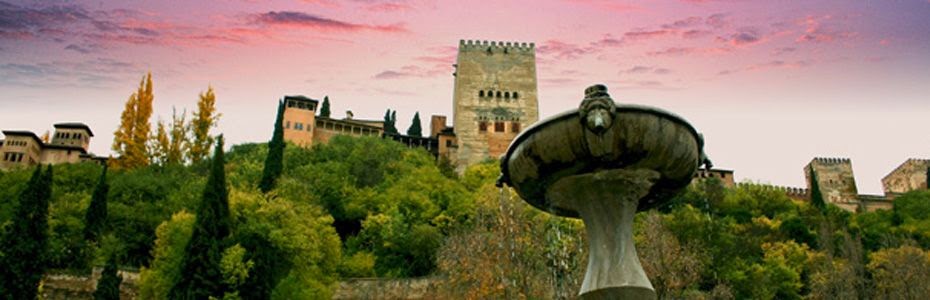
Must see places in Andalusia, Spain

If you are a muslim traveller or an islamic architecture lover those are the 7 things you must see in Granada

Top 10 foods to try in Morocco

One of the great cuisines of the world, Moroccan cooking abounds with subtle spices and intriguing flavour combinations.

Top Five Must See Things in Cordoba, Spain

Cordoba قرطبة in the Andalucia province of southern Spain is a city with more than 2,500 years of developed history.

ChefChaouen, the blue city in Morocco

Located just a few hours by bus from Tangier and far enough off the beaten track to dissuade many tourists, Chefchaouen is quiet enough for those visitors overwhelmed by the busy medinas of Fez and Marrakech, and has just enough of what is quintessentially Moroccan to be of interest to other travelers looking for something a bit more authentic.

Fes, Morocco

The most mystical of Morocco's imperial cities, Fez. Capital and spiritual center of Morocco, this city is situated in a narrow valley against the backdrop of the Middle Atlas

Mostrando entradas con la etiqueta Andalusia. Mostrar todas las entradas

lunes, 22 de febrero de 2016

Dar al Horra Palace - Islamic things you must visit in Granada


Picture shared via http://alhambracadabra.blogspot.com.es


Text via www.granadatur.com 

It was built in the 15th century on the remains of the destroyed palace of the Ziri kings. It very interesting as it is the only one, out of several which were in the Albayzin, which has been preserved. The name “Dar-al-horra” (House of the Honest Lady) seems to honour one of its inhabitants: Aisha, the mother of King Boabdil, the last of the Muslim monarchs in Spain.

After the conquer of Granada in 1492 by the Catholic Monarchs, the Muslims ceded the Palace an the surrounding houses to the Kings’ secretary, Hernando de Zafra. Afterwards, Queen Isabella decided to found ther the Santa Isabel la Real Convent. The building was owned by the religious order until the beginnings of the 20th century when it was purchased by the government. Today it has been catallogued as Heritage of Cultural Interest.


Picture shared via http://alhambracadabra.blogspot.com.es

Its structure and decoration is the characteristic of the Nasrid art. It has two floors in two of its sides and a tower in its North side. We can admire a central courtyard or patio, two “porticos” in the lower sides and a little pool with fountain by the South portico.

Picture shared via http://alhambracadabra.blogspot.com.es

The North side is the most interesting in the building; it has two floors and a tower. On the ground floor, the portico is formed by three horseshoe’s archs on columns and it is covered by a magnificent Arab-style ceiling made of simple wood and decorated with geometrical shapes. 

In the centre a door with horseshoe arch gives access to a rectangular hall with side rooms and a watchpoint in the centre from where one can see part of the district. The different rooms are divided with archs and covered by Arab-style ceilings. In some walls there still are some Arabic inscriptions.

martes, 22 de diciembre de 2015

What to see in Seville, Ishbiliya إشبيلية in muslim times

The Islamic kingdoms of medieval Spain are legendary for their artistic and architectural glories. They are also famous, although perhaps at times through rose-tinted spectacles, for centuries of co-existence between Muslims, Jews and Christians, and for the flowering of a rich culture which drew on the best of the Religions of the Book.

Nowadays, the best-known (and most visited) of the cities of these medieval kingdoms are Granada, home to the Alhambra palace, and Cordoba, site of the breathtaking Mezquita mosque with its forest of red and white arches.

But Seville, now a sprawling modern city, also deserves recognition for its Islamic-influenced cultural heritage. Seville was founded as the Roman city of Hispalis, and was known as Ishbiliya (Arabic:إشبيلية) after the Muslim conquest in 712.

During the Muslim rule in Spain, Seville came under the jurisdiction of the Caliphate of Córdoba before becoming the independent Taifa of Seville; later it was ruled by the Muslim Almoravids and the Almohads until finally being incorporated into the Christian Kingdom of Castile under Ferdinand III in 1248

The Moorish urban influences continued and are present in contemporary Seville, for instance in the custom of decorating with herbaje and small fountains the courtyards of the houses. However, most buildings of the Moorish aesthetic actually belong to the Mudéjar style of Islamic art, developed under Christian rule and inspired by the Arabic style. Original Moorish buildings are the Patio del Yeso in the Alcázar, the city walls, and the main section of the Giralda, bell tower of the Seville Cathedral.


You can visit this city in our tour Spain & Morocco of  10days / nights

Torre del Oro

Overlooking the river is the Torre del Oro, which began life in the 13th century as a Moorish watchtower, part of the city walls that secured one end of a large chain that blocked off entrance to the harbor, which was at the time right in the center of Seville.

When the Catholic kings regained Seville and the city was granted the monopoly on all trade with the New World, the tower became an inspection point for taxing all cargoes before they were unloaded at the port.

The river eventually silted up, forcing the port to move to Cadiz, and the tower was no longer needed, and eventually the city walls around it were demolished. But the tower remained, later used as a prison.

Today it houses a maritime museum. Inside are displays relating to the Guadalquivir, and its role in navigation history. You’ll find ship models (including the three with which Columbus set out from Seville), maps and drawings, figureheads and a fine collection of navigation instruments.

Maria Luisa Park (Parque de María Luisa)

When Seville hosted the 1929 Exposición Ibero-Americana, this whole southern end of Seville was transformed into the fairgrounds, and various nations hired cutting-edge architects to design eye-catching pavilions were they could showcase their arts and technology.

Other pavilions were constructed to show off Spain’s on industry and innovation.

After the fair, several nations kept their pavilions as consulates, other buildings were turned into museums, and the entire park became Seville’s back yard.

Stretching along the river, Parque de María Luisa is a green space filled with fountains, gardens, palms, orange trees, Mediterranean pines, flower beds, pools and walkways, liberally dotted with benches and decorated throughout by colored tile work. Plaza de España defines one end, while at the other end two of the largest pavilions have become museums featuring archaeology and popular arts. Around the edges are consulates, including those of Peru and Colombia, and other buildings in Art Nouveau and Art deco styles, many of them also former fair pavilions.

Plaza de España

The focal point of the 1929 Ibero-American Exposition, Plaza de España is the work of architect Aníbal González, who blended elements of Spanish baroque, Mudéjar revival and the Art Deco that was popular at the time.

The towers were inspired by those on the great cathedral at Santiago de Compostella, and all around the immense crescent plaza are alcoves with colored tiled scenes representing the various provinces of Spain. Behind this is a wide arcaded gallery with views into the plaza and the moat that surrounds it.

The water feature is enhanced by boats and by ornate bridges crossing at intervals. Scenes from the movie Lawrence of Arabia were filmed here, and more recently scenes from two episodes of Star Wars. The fountain at the center of the plaza is lighted at night.

Jardines Reales Alcázar Gardens

Lovely and complex, the gardens are arranged, like the palace itself, into a series of garden rooms, through which you can stroll at leisure. And like the palace, some are intimate, some grand and soaring.

Wander among them to find fountains, tall topiary arches, walls of colored tile, carefully tended beds inside perfectly trimmed hedges, and other places where nature and Seville’s Mediterranean climate have been allowed to tend the garden.

Look especially for the spacious tree-shaded English Garden, the romantic Poet’s Garden, the Jardin de la Danza and the garden of Carlos V. The gardens are especially welcome in the summer, when their shade and fountains offer a respite from the heat.

Real Alcázar (Royal Palace)

Begun by the Islamic rulers in 712, building was continued in the 1360s by King Pedro, who favored the Mudéjar style, a revival of the Moorish architecture and decoration.

One of the oldest European royal palaces that are still in use, the Alcázar seems to flow in and out between almost overwhelming interiors and elegantly arranged patios, whose decoration is no less splendid, but brighter and airier for being open to the sky.

Each of these spaces – grand rooms or exquisite patios – is a jewel box on its own, and together they form one of the world’s most opulent palaces.

Beyond their splendor, in these rooms and tiny enclosed gardens are a millennium of history. Their architecture is a catalog of changing tastes and styles, from the earliest Arabic period through the Mudéjar extension of Moorish elements as they blended with Gothic in the late Middle Ages and into the Renaissance, Baroque and even later periods.

 Highlights are the delicate stone traceries of the Patio del Yeso and carvings of the Doncellas Patio, and the soaring and intricately tiled walls and dome of the Salon de Embajadores.

La Giralda

In proclaiming this former minaret a World Heritage Site, UNESCO called it “the masterpiece of Almohad architecture.” Built 1184-96, the tower, considered the finest of the three remaining great Almohad minarets, was designed not only to call the faithful to prayer, but as an observation point to guard the city.

So important was the tower to the Moors that they wanted to destroy it when they knew their city would fall to the Christian kings in 1248. King Alfonso X threatened death to the entire city if a single stone were removed, saving it for posterity – or maybe so he’d have a place from which to view his restored domain, which he promptly did – on horseback.

In the Renaissance era (1560-68), the top of the belfry was extended and the present balconies added, but everything below the bells is the original Almohad minaret, its walls built of brick trellis work forming different patterns on each side, highlighted by niches and windows. La Giralda’s beautiful design has inspired a number of other buildings, among them the clock tower of the Ferry Building in San Francisco, the Wrigley Building in Chicago and The Biltmore in Miami.

Seville Cathedral


One of the three largest in the world (measured by volume it’s even bigger than St Peter’s in Rome), Seville’s cathedral is resplendent in gold and silver, all part of the riches that flowed through Seville when the city had the monopoly on trade with the New World.

The high altar is nearly 120 feet tall, a tour-de-force of woodcarving with all of its statues and surfaces covered in gold.

To one side, the tomb of Christopher Columbus is held high by four giant figures, and several chapels have ornate altars and paintings by major Spanish artists. The Sacristy holds some of the church’s vast treasury of intricate reliquaries of precious metals and stones, as well as paintings by some notables. The church follows the footprint of the mosque that it replaced, and the courtyard planted in orange trees was its courtyard.

Re

miércoles, 15 de abril de 2015

Must see places in Andalusia, Spain

malaga-spainThe region of Andalusia stretches over 87 268 km² of land. Andalusia makes up 17% of Spain. This autonomous region has lots to offer to its visitors.

You can visit Andalusia in our tour Spain & Morocco of  10days / nights

Here are some highlights in this fascinating part of Spain.      

The natural beaches of Cabo de Gata, Almeria. This area is named Cabo de Gata after the mineral Agate (agata) which used to be mined in that area. As your drive through this National Park you will see the landscapes vary. From expanses of desert with cactus and prickly pear trees to beautiful rustic beaches. You will discover villages that look like they came straight out of the Wild West. It´s easy to see how this area has attracted so many film producers. Recently Ridley Scott filmed scenes for the film Exodus at Playa de los Genoveses. The bird scene from Indiana Jones and the Last Crusade was also filmed here.


The Alpujarra villages. These small villages extend across a large area in Granada and Almeria provinces. The region is beside the Sierra Nevada mountain range and boasts dramatic landscapes. A day out around the Alpujarras is a unique experience. The locals thrive on the sale of local craftwork and delicious food from that area. This group of villages is currently on the UNESCO waiting list to be added as a World Heritage site. It has a history of Silk production and was once one of the main producers of silk in the world. You will love this area of Andalusia if you enjoy nature, walking, and local crafts. You may like to party in the Alpujarra at one of the local fiestas in the summer months.


 The Alhambra Palace and Generalife. This group of palaces and gardens is a UNESCO World Heritage site. Located in the city of Granada, this site received 2,315,017 visitors last year. (2013 figures) This began as a fortress over 1000 years ago. As the years passed it changed gradually as different monarchs conquered the Kingdom of Al Andalus. A fascinating history lies before any visitor to this spectacular place. The intricate plasterwork on its walls seems unending. The reflective details in the architecture adds symmetry to the Nasrid palaces. As you wander through the Alhambra complex you may think you have travelled back in time.


Cordoba. Yet another UNESCO World Heritage site, the Mezquita of Cordoba is well worth a visit. Building of this impressive mosque began in 786 and took around 200 years to complete. This Cathedral mosuqe is located in the centre of old quarter of Cordoba. The central hall is full of hundreds of columns and arches. Many of these stone columns came from other countries across the empire although at a first glance they look alike. Cordoba is also well known for it´s colourful patio festival. Although it takes place in May you can visit the patios at other times of the year too. The sunset across the roman bridge is stunning. A walk around the old streets after dark is particularly magical.

 
Malaga. Although the coastal towns of Malaga are popular for their beaches and nightlife, the old quarter of Malaga must be included on your visit. The city has it´s own fortress or Alcazaba and the impressive Roman amphitheatre too. The views from the Alcazaba over the coastline and the port are well worth the jaunt up the hill. (take the bus) T. As you walk around the city centre you may see flower sellers with white jasmine flowers for sale. Known locally as biznagas they make an unusual gift to take home. Don´t miss the Calle Larios, the main commercial street or the bar Pimpi, a must see for any visitor to Malaga.

malaga-spain

Ronda is an inland town in the Malaga province. The town is seperated in two by a vast gorge. The two areas of the old town and the newer part where the commercial area is. The surrounding countryside and views from the bridge will make for impressive holiday photos. This bridge puente nuevo inspired Ernest Hemingway in For whom the bell tolls. Ronda´s Plaza de Toros has a museum which displays different aspects of this spanish tradition. Ronda makes a good destination for a day trip if staying along the Costa del Sol or in Marbella.

Ronda, Malaga, Spain

Seville. The city of Seville is famous for its Easter processions and it´s traditional Feria de Abril. If you have chance to visit at Eastertime you will be able to enjoy the intense atmosphere of the Easter processions. The Feria de abril follows after easter and lasts for 10 days. Colourful flamenco dresses and lots of bottles of manzanilla dry wine are enjoyed each year at the fair. Monuments worth visiting in the city are the Cathedral of Seville with the its famous Giralda, the Alcázar and the Archivo General de Indias. The three buildings are UNESCO listed. The Plaza de España, Parque Maria Luisa  and the neighbourhood of Triana are also recommended for any visitor.


Cadiz. This coastal city is still one of the most important seaports in Spain. This city is the oldest in Spain, founded in the 11th century B.C. It´s often called the Tacita de Plata, meaning the silver tea cup. There is something special about Cadiz. The atmosphere of the city and the friendly locals make any visit enjoyable. Go and taste some tapas in the Barrio de La Palma,  just a short walk from the beach.  Take a walk along the fortified walls beside the sea and see the San Esteban Castle. You can also see Cadiz from above at Torre Tavira, using their camara oscura.


Cadiz
The National park of Doñana is a birdwatchers paradise. This park located in Huelva province is yet another UNESCO listed site. With a large number of protected birds in it´s grounds you can enjoy birdwatching in a beautiful natural setting. Flamingos, geese, vultures, kites and many others are here this impressive park. 


Doñana National Park, Andalusia, Spain


viernes, 16 de enero de 2015

Sacromonte, the Flamenco&Gipsy Quarter in Granada

Sacromonte, meaning "sacred hill" is at the very top of the valley at the edge of the Albayzin, called Valparaiso outside the old city. With stunning views of the Alhambra on the left and the Albayzin on the right, Sacromonte forms the Gitano (Gypsy) quarters of Granada. During the day it is a pleasant stroll to explore the architecture comprised of small, whitewashed buildings and "caves" built into the hillside.


At night Sacromonte awakens with multiple, hole-in-the-wall Flamenco bars that truly come alive only when most of the city begins its nightly slumber. To experience Gitano culture in its most raw form, the Flamenco music, song and dance found in these clubs are often completely impromptu as various Flamenco singers, dancers and musicians put together a mosaic of sound and movement to the delight of their onlookers.


The history of the Sacromonte is significant in that its name is derived from the Sacromonte Abbey, which in many respects is central to Granada's transition from Moorish stronghold to its current Catholic identity.  The abbey is said to be built over the catacombs of the bones of Saint Cecilio, the patron saint of Granada, and has been key in the propagation, whether fabricated or re-discovered, of the city's pious origins.


The legend states that the catacombs are the site of Saint Caecilius's martyrdom, and the abbey preserves Lead Books of Sacromonte.

The supposed relics of Caecilius and eleven other saints' bones, ashes and the oven in which they were believed to have been burned. It also possesses the inscribed lead plaques and books that were found with the supposed relics, but which were subsequently officially dismissed as forgeries.

The Morisco population of Granada had been expelled to other parts of Spain following the Morisco Revolt of 1568 (except for those few trusted Moriscos who had served in the royal forces, and who were permitted to remain in the old Moorish quarter of Albaicin adjacent to Valparaiso). By the 19th century, the area had become home to a substantial Gitano community, who built their homes in caves excavated from the soft rock of the hillside. The area became famous for Flamenco music and dancing, but major floods and forced evacuations in the 1960s left the neighborhood population dramatically reduced. Since the early 1990s, however, the area has slowly become developed as a tourist attraction, and as a centre of Gitano culture.

martes, 16 de diciembre de 2014

Top Five Must See Things in Cordoba, Spain

Cordoba قرطبة in the Andalucia province of southern Spain is a city with more than 2,500 years of developed history. Established around the 8th century BC, Cordoba at one point was probably the world’s most populous city. Today, with only around 325,000 inhabitants, it’s actually one of the smaller cities in Spain but that doesn’t stop it being one of Spain’s most visited cities.
Cordoba is not only historic and beautiful, there are also so many things to see and do it’s often difficult to choose. If you are planning a first trip to Cordoba, or even a second or third one and haven’t seen every must see place on previous trips, there are five must see things everyone who visits Cordoba should see.

You can visit Cordoba in our Spain & Morocco Tour and Andalusia Routes

1. Great Mosque of Cordoba/Mezquita-Catedral 
 One of the most beautiful mosques in Spain, the Great Mosque of Cordova, or Mezquita-Catedral (Mosque Catheddral) is a World Heritage Site known for its stunning architecture. It is the world’s third largest mosque, although today it is used as a Roman Catholic church. Muslims in Spain have been lobbying the Spanish government since the year 2,000 to be allowed to pray in the mosque, but so far have been denied permission.
Construction on the mosque began in the year 785.

2. Alcazar
 The big attraction here are the gardens, laid out in descending terraces with typical Islamic rectangular pools - some of the most beautiful in Andalucia - perfect for a cooling waterside break on a hot spring day.


3. The Jewish Quarter "La Juderia"
The Jewish quarter of Cordoba goes back to the time of the Romans and consists of a network of narrow streets full of shops, restaurants and cafes, synagogues and museums. A must see is the Bullfight Museum and don’t miss the Zoco, where in the summer you can see flamenco dancers performing. You can visit too the 14th century synagogue and a restored Sefardi house. 


4. The Calahorra Tower and its "Al-Andalus living museum"
 The Al-Andalus living museum is located in an old Moorish fortress, and recreates the time of maximum splendour in this Andalusian city. The museum is in the Calahorra Tower, opposite the Great Mosque, at the end of the Roman Bridge. Its aim is to provide a recreation of the Cordoba of the period between the 9th-13th centuries.

5. ‎ Madīnat az-Zahrā  مدينة الزهراء 
 Medina Azahara (Arabic: مدينة الزهراءMadīnat az-Zahrā: literal meaning "city of the flower") is the ruins of a vast, fortified Arab Muslim medieval palace-city built by Abd-ar-Rahman III al-Nasir, (912–961) Umayyad Caliph of Córdoba, and located on the western outskirts of Córdoba, Spain. It was an Arab Muslim medieval town and the de facto capital of al-Andalus, or Muslim Spain, as the heart of the administration and government was within its walls. Built beginning in 936-940, the city included ceremonial reception halls, mosques, administrative and government offices, gardens, a mint, workshops, barracks, residences, and baths.

"Al-Andalus living museum" in the Calahorra Tower in Cordoba

The Al-Andalus living museum is located in an old Moorish fortress, and recreates the time of maximum splendour in this Andalusian city.

The museum is in the Calahorra Tower, opposite the Great Mosque, at the end of the Roman Bridge. Its aim is to provide a recreation of the Cordoba of the period between the 9th-13th centuries, at a time of brilliant cultural, artistic and scientific achievement. Its modern facilities include a system of headphones and infrared data transfer that guide you through the eight themed rooms with dioramas.

The Calahorra Tower was built by order of Enrique II de Trastamara to defend the city when under attack from his brother Pedro I 'the Cruel'. It was used as a prison in the 18th century, a girls' school in the 19th, and today houses the Roger Garaudy Museum of the Three Cultures. The interactive guided tour illustrates the many ways in which Jewish, Christian and Moslem cultures thrived side by side in Medieval Cordoba. Visitors especially enjoy the excellent scale models of the Cordoban Mosque and other well-known Andalusian buildings and the spectacular view over Cordoba from the battlements at the end of the tour.


Room 1
The first lounge of the museum has as aim to welcome the visitors, who enter into an historical place, of dreams, where a unique language.
The visit leads us to the period which encloses the centuries IX and XIII, Cordoba was at that time the biggest city and the faith, between Occident and Orient.... here begins the real renaissance.


Room 2
On the right there is a second lounge, known as the Philosopher Lounge, in fact inside the Muslim figures such as Averroes or Ibn al Arabi, the Jewish Maimonides or the Christian Monarch Alfonso X the Wisemen.

All of them keep a special link with our city.
The ambiance and the spoken explanation are oriented to strengthen the importance of the thought of that moment, the wisdom, without being separated from the science, which are treated in the following lounges, neither the faith.


Room 3
The next lounge is the one dedicated to the Sciences and the Techniques, and in it the technological progresses are shown and they are materialized in Al andalus, such as the new techniques for the agriculture and the irrigation. There is a wonderful scale plan of the Noria mill, which was used by the Caliph Alcazar, and which is conserved by the river.

Other Cordovan figures are treated such as Abulcassis al-Zahri a surgeon and the al-Idrisi, known for his Map of the world, Tabula Rogeriana


Room 4
We go up the stairs and we arrive to the second floor, where we find the known lounge as The Summit: the palace and the mosque, referring to the city-palace of Madinat al Zahra and the Mosque Alhama of Cordoba. It stands out the reception which the caliph Abd Al–Rahman III gave to a Christian monk sent by the Byzantine Emperor

In front there is the Mihrab of the Mosque in Cordoba, carried out in Al-hakam II Period, with materials brought from the orient, thanks to the good relationships.


Room 5
In the following lounge, thanks to a wonderful scale model of the nazari palace of the Alhambra and his complete explanations and effects of light and sound, we get to entry into this marvellous place, from the sunset till the end of it, in this moment the little rooms are illuminated.
The Comares Tower, the Lounge of Dos Hermanas, the Leones Courtyard in which there is a wonderful fountain... all is studied and elaborated with details, and easily to know by the visitors. 

Room 6
It is very close to the granadine palace where the Lounge of Andalusi Music, it is a very little room very interesting. The visitor enters into the richest al-Andalus, at the same time you are under the Mihrab of the Mosque Alhama of Cordoba, one of the most beautiful and impressive places that Islam could create.

The lounge is completed with a little collection of musical instruments belonging to the Andalusi period, and witness of its
rich culture. 
 
Room 7
We arrive to the third and last floor of our tower, and in it we enter into one of the most special lounges of the museums, dedicated to the Mosque Aljama of Cordoba. An exceptional mock-up is in the room, a mock-up who looks in great detail all the outside covers and the most important points of the interior, like the Skylight of Villaviciosa or the mihrab. As in the previous case devoted to the Alhambra, the mock-up is set with phrases and high quality sound effects.

Room 8
From the lounge dedicated to the monument of our city we pass to another which shows us others that without having the artistical and historical relevance they represent the fingerprint of those who lived and shared our city.

Among the columns of the Mosque, under the red and the whiteness of their voussoirs, there are the Caliph Alcazar, the Royal Baths, the Almodovar Door, the Craft Market and the Synagogue... and the river Guadalquivir, the witness of our history. 

Room 9
We end our visit with the Live Museum of Al-Andalus, but before we have a last stop, the lounge called Multivision, where we will enjoy an audiovisual projection which is about the three cultures and it is the theme of the museum. So every hour you have this projection.

Here the visit ends, however it is better to visit it and at the same time go up to the terrace in order to enjoy the most beautiful sight of our city.

Text by: www.artencordoba.com
Photos by: www.artencordoba.com
                  www.nuriacalvodiseno.tk

lunes, 15 de diciembre de 2014

مدينة الزهراء‎ Madīnat az-Zahrā The city of the flower

When you go to Córdoba, besides visiting the city, you must visit the archeological remains of Medina Azahara, one of the great works of Islamic art in Andalucía.


Medina Azahara (Arabic: مدينة الزهراءMadīnat az-Zahrā: literal meaning "city of the flower") is the ruins of a vast, fortified Arab Muslim medieval palace-city built by Abd-ar-Rahman III al-Nasir, (912–961) Umayyad Caliph of Córdoba, and located on the western outskirts of Córdoba, Spain. It was an Arab Muslim medieval town and the de facto capital of al-Andalus, or Muslim Spain, as the heart of the administration and government was within its walls. Built beginning in 936-940, the city included ceremonial reception halls, mosques, administrative and government offices, gardens, a mint, workshops, barracks, residences, and baths. Water was supplied through aqueducts.

10,000 men worked in its construction using the best materials: precious metals, marble, polychrome stones, etc.

Medinat-al-Zahra was organized in three big terraces surrounded by a wall. In the upper part was the royal palace, with the rooms of the caliph and his family; the middle one was the bureaucratic and administrative area, with the halls and gardens; the lower one was destined for the houses of the people, as well as for the souk and mosque.

Its location in the foothills of Sierra Morena made it possible to design an urban program in which the location and physical relationships between the various constructions were expressive of the role of each in the setting.

The palace was located at a higher level, and staggered its buildings along the side of the mountain in an expression of clear preeminence over the urban hamlets and the Aljama Mosque spread across the plains below.

Following the terraces, the first corresponds to the residential area of the caliph, next comes the official area including the houses of the viziers, the guard-room, administrative offices and gardens.

Next is the city proper, with housing, crafts, and the great mosque of the two lower terraces separated by another wall in order to isolate the upper palace complex. Archaeological research has revealed an urban morphology characterized by the existence of large areas of undeveloped land, which serves to empty the entire southern front of the fortress, ensuring privacy and maintaining an open, idyllic country landscape.

The only spaces built on the lowest level are two broad bands: the western, with an urban management orthogon, and the eastern, with less rigid planning.

Popular legend holds that the Caliph named az-Zahra, or Azahara, after his favorite concubine, and that a statue of a woman stood over the entrance. Others, imagining his demanding lover, say that he built this new city just to please her. The truth, however, has probably more to do with politics than love.

 Abd ar-Rahman III ordered the construction of this city at a time when he had just finished consolidating his political power in the Iberian Peninsula and was entering into conflict with the Fatimid dynasty for the control of North Africa.

 Zahara means 'shining, radiant or blossoming' in Arabic: the name communicates aspirations of power and status, not romantic love. Az-Zahra is the most common title for the daughter of the Prophet Muhammad Fatimah az-Zahra. As such, the Fatimid dynasty of North Africa adorned many buildings and even towns with her name.


viernes, 12 de diciembre de 2014

The Partal palace, one of the oldest areas of the Alhambra de Granada

The Partal is one of the oldest areas of the Alhambra and it was probably built by order of the Sultan Mohammad III (1302-1309). 

The name comes from an Arabic word meaning "the portico", and is the name given to the remains of the residence of Sultan Yusuf III, the northernmost of the Nasrid Palaces.

It was built following the same design as the ‘Palacio de Comares’: a rectangular court with a central ‘alberca’ and opposing edifices in the smaller sides.
The environment of the area suggests that it was the rest area of the Muslim nobility of the palace. They had a Muslim cemetery, “Rawda”, whose name was used to name the door “Rauda” that today is reduced to the foundations. 

Initially, this palace area was not attached to the Alhambra and when it passed to the control of the state, it was joined to the resort.


Although great original features have been lost, such as the residence of Yusuf III, demolished for the structural damages, the restoration is very similar to the past as the structure of the Partal, the tower de la dama or the pool.

In the 19th century, the Partal was in a very bad condition. It was restored by Torres Balbás. He followed a conservative style instead of the Romantic and decorative restorations that were usually done at that time in the Alhambra

The "Damas" Tower is the most important among the buildings of the magnates that lived around the Royal Palace in Arab times, and the decoration is the oldest of the Alhambra. This tower, in the eighteenth century, was called Torre del Principe, because here lived Fernando VI, son of Philip V, and was bought by the German Arthur Gwinner in 1886, and later it was transfered to the Spanish state in 1891, but not entirely. 

 Until the year 1924, when the tower's restoration was completed, it has gone through many alterations carried out by its inhabitants in order to live there 

Phothos by: objetivogranada.ideal.es Manu Rubio

martes, 25 de noviembre de 2014

The Albaycin al-bayyāzīn, the old Arab Quarter in Granada

The Albaycin is the old Arab Quarter. It comprises approximately the area between the hill of the Alhambra, the hill of San Cristobal, the Sacromonte and Elvira.  It was declared a world heritage site in 1984, along with the more famous Alhambra.

The name albaicín appears to derive from the Arab word al-bayyāzīn, pronounced with an imala in the Granadan Arabic accent as al-bayyīzīn, meaning "the falconers", although this is disputed by some linguists.

El Albayzin in Granada Spain is a wonderful neighborhood to explore on foot. While strolling along the whitewashed streets, visitors can admire old Moorish homes, beautiful fountains, and attractive plazas. Among the more renowned plazas is the Plaza de San Nicolas. It is at this plaza that the Mirador de San Nicolas can be found. This "mirador," or lookout point, offers amazing views of the Alhambra, especially at sunset.

 The Albaycin is like a different world within Granada. This is due to the strong Muslim influence in this area. It was the place where the first Ziri court was built in the eleventh century.

The city descended from Saint Nicholas to the banks of the River Darro. The Albaycin featured luxurious carmenes and public baths, like the Banuelo

There is a lot to see in the Albaicin Quarter, including remnants of an old gate, Puerta Elvira, to the city and numerous cisterns that harken back to days gone by.

Despite the development that followed the Christian conquest, the Albayzín still bears witness to the medieval Moorish settlement, as its urban fabric, architecture and main characteristics (form, materials, colours), were not changed when it was adapted to the Christian way of life, to survive as a remarkable example of a Spanish-Moorish town.


Nowdays, Albaycin Bajo has a very North African feel, and you will find kebabs and falafel on the local restaurant menus. As for the shops, they offer all kinds of things, including Moroccan handicrafts. Many are found along Calle Caldereria Nueva, which extends from the Albaicin to some of the city's more modern neighborhoods.


Next to the Arabic Quarter in Granada it's  Sacromonte. A neighborhood of sorts, Sacromonte is known for its gitano (gypsy) heritage and features some interesting caves. It's also where the Granada flamenco shows take place.

lunes, 17 de noviembre de 2014

Madrasa ﻣﺩﺭﺴة of the Nasrid monarch Yusuf I in Granada

In the first half of the fourteenth century, the Nasrid Sultan Yusuf I ordered the construction of a madrasa next to Granada's congregational mosque.

Fragments from the original façade are preserved in the Museo Arqueológico y Etnológico de Granada, including an inscription, which states that the building was dedicated in the month of Muhurram in 750 (March or April 1349).


It is located on the street now known as Calle Oficios. The madrasa was built at the heart of the city, near the main mosque (now the site of the Granada Cathedral) and the Alcaicería, then the elite bazaar where silk, gold, linen and other cloth were traded. Ibn al-Khatib was an early student there; among his teachers were Ibn al-Fajjar, Ibn Marzuq, and Ibn al-Hayy (language and law); Ibn al-Hakam and the poet Ibn al-Yayyab (rhetoric); and Sheik Yahya ibn Hudayl (medicine and philosophy).

The building

As was typical of the works of Yusuf I, the building was splendid, with a white marble entrance. The building was originally organized around a pool in the center.

The only surviving part of the school is the prayer room. It is a square-shaped room oriented by its mihrab. Carved, polychrome plaster covers the upper portions of the walls and doorjamb. Calligraphy consistent in style and content with other Nasrid monuments is an integral part of the decoration. Muqarnas in the four corners of the room form an upward transition into an octagonal drum that has sixteen windows with pierced screens.

Above the prayer room is an octagonal wooden ceiling with interlaced star shapes, open in the center and topped by a smaller octagonal drum with sixteen windows and a plaster-decorated ceiling. (Segments of the ceiling have been modified during restoration.)

The façade was decorated with inscriptions of poetry and philosophy. Among these were the words "If in your spirit you provide a place for the desire to study and to flee from the shadows of ignorance, you will find in it the beautiful tree of honor. Make study shine like stars to the great, and to those who are not, bring to them the same brilliance."

Baroque façade of the Madrasa of Granada (detail).
After the completion of the Reconquista and the conversion to the Cabildo an adjacent house was Baroque, so that what we have today is essentially an 18th-century building with elements of older buildings. The oratory or mihrab is original from the 14th century; the Sala de los Caballeros XXIV is Mudéjar.

annexed to enlarge the building. The octagonal Mudéjar Sala de Cabildos was constructed in this era; its 1513 decoration included an inscription alluding to the Christian conquest of the city. Eventually the pool was filled in and converted to other uses, although even after the modifications of 1554–1556, Francisco Henríquez de Jorquera describes a patio with a pool and a garden. The building was subject to major modifications, especially in the 1722–1729 at the height of the

The building, which belongs to the University of Granada, underwent extensive archeological excavations in 2006–2007. As of February 2009, restoration of the interior was just beginning, and the building is not currently open to the public.

History

The madrasa is located on this street called Calle Oficios
The Madrasa functioned as a university until late 1499 or early 1500, under the Treaty of Granada (1491), under which the sultan Boabdil of the Emirate of Granada surrendered to the Catholic Monarchs Ferdinand and Isabella. However, towards the end of 1499, the policy of tolerance and compliance with that treaty under archbishop Hernando de Talavera, came to an abrupt end with the arrival in Granada of Gonzalo Jiménez de Cisneros, who substituted a policy of forced religious conversions.

This new policy led to an uprising in Granada, above all in the Albaicín. Cisneros took advantage of the situation to assault the Madrasah, the contents of whose library was brought to the plaza of Bib-Rambla and burned in a public bonfire. Once pillaged and closed, the building was designated in 1500 by Ferdinand II to be the new Casa del Cabildo (city hall).

In 1858 the town hall moved to the Plaza del Carmen, and the building was sold to be used as a textile warehouse. Two years later, the principal inscription of the Mihrab was discovered. There was also some fire damage in this era; the Echeverría family, owners of the building, hired Mariano Contreras, the same architect who restored the Alhambra, to undertake the repairs.

The city bought back the building in the early 20th century, leading to further restoration work in 1939. There was an unsuccessful attempt in 1942 to turn the building into the seat of a new Instituto de los Reyes Católicos del Consejo Superior de Investigaciones Cientificas ("Catholic Monarchs Institute of the Superior Council of Scientific Investigations"). In 1976, the building became part of the University of Granada.