
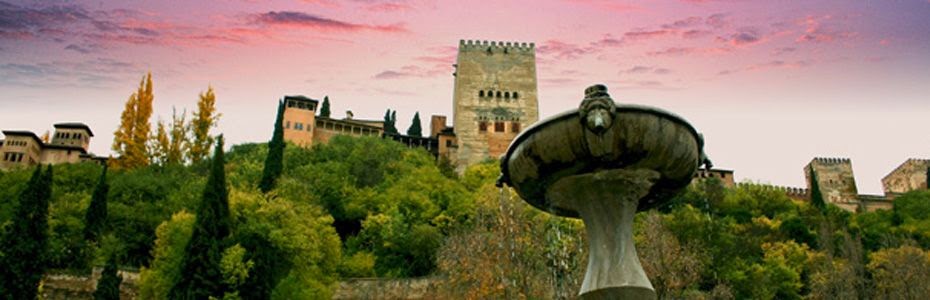





The Partal is one of the oldest areas of the
Alhambra and it was probably built by order of the Sultan Mohammad III (1302-1309).
The name comes from an Arabic word meaning "the portico", and is the
name given to the remains of the residence of Sultan Yusuf III, the
northernmost of the Nasrid Palaces.
It was built following the same design as the ‘Palacio de Comares’: a
rectangular court with a central ‘alberca’ and opposing edifices in the
smaller sides.
The environment of the area suggests that it was the rest area of the
Muslim nobility of the palace. They had a Muslim cemetery, “Rawda”,
whose name was used to name the door “Rauda” that today is reduced to
the foundations.
Initially, this palace area was not attached to the
Alhambra and when it passed to the control of the state, it was joined
to the resort.

Although great original features have been lost, such as the residence of Yusuf III, demolished for the structural damages, the restoration is very similar to the past as the structure of the Partal, the tower de la dama or the pool.
In the 19th century, the Partal was in a very bad
condition. It was restored by Torres Balbás. He followed a conservative
style instead of the Romantic and decorative restorations that were
usually done at that time in the Alhambra.
The "Damas" Tower is the most important among the buildings of the
magnates that lived around the Royal Palace in Arab times, and the
decoration is the oldest of the Alhambra.
This tower, in the eighteenth century, was called Torre del Principe,
because here lived Fernando VI, son of Philip V, and was bought by the
German Arthur Gwinner in 1886, and later it was transfered to the
Spanish state in 1891, but not entirely.
Until the year 1924, when the tower's restoration was completed, it has
gone through many alterations carried out by its inhabitants in order
to live there
Phothos by: objetivogranada.ideal.es Manu Rubio


