
Must see places in Andalusia, Spain

If you are a muslim traveller or an islamic architecture lover those are the 7 things you must see in Granada

Top 10 foods to try in Morocco

One of the great cuisines of the world, Moroccan cooking abounds with subtle spices and intriguing flavour combinations.

Top Five Must See Things in Cordoba, Spain

Cordoba قرطبة in the Andalucia province of southern Spain is a city with more than 2,500 years of developed history.

ChefChaouen, the blue city in Morocco

Located just a few hours by bus from Tangier and far enough off the beaten track to dissuade many tourists, Chefchaouen is quiet enough for those visitors overwhelmed by the busy medinas of Fez and Marrakech, and has just enough of what is quintessentially Moroccan to be of interest to other travelers looking for something a bit more authentic.

Fes, Morocco

The most mystical of Morocco's imperial cities, Fez. Capital and spiritual center of Morocco, this city is situated in a narrow valley against the backdrop of the Middle Atlas

Mostrando entradas con la etiqueta sacromonte. Mostrar todas las entradas

viernes, 16 de enero de 2015

Sacromonte, the Flamenco&Gipsy Quarter in Granada

Sacromonte, meaning "sacred hill" is at the very top of the valley at the edge of the Albayzin, called Valparaiso outside the old city. With stunning views of the Alhambra on the left and the Albayzin on the right, Sacromonte forms the Gitano (Gypsy) quarters of Granada. During the day it is a pleasant stroll to explore the architecture comprised of small, whitewashed buildings and "caves" built into the hillside.


At night Sacromonte awakens with multiple, hole-in-the-wall Flamenco bars that truly come alive only when most of the city begins its nightly slumber. To experience Gitano culture in its most raw form, the Flamenco music, song and dance found in these clubs are often completely impromptu as various Flamenco singers, dancers and musicians put together a mosaic of sound and movement to the delight of their onlookers.


The history of the Sacromonte is significant in that its name is derived from the Sacromonte Abbey, which in many respects is central to Granada's transition from Moorish stronghold to its current Catholic identity.  The abbey is said to be built over the catacombs of the bones of Saint Cecilio, the patron saint of Granada, and has been key in the propagation, whether fabricated or re-discovered, of the city's pious origins.


The legend states that the catacombs are the site of Saint Caecilius's martyrdom, and the abbey preserves Lead Books of Sacromonte.

The supposed relics of Caecilius and eleven other saints' bones, ashes and the oven in which they were believed to have been burned. It also possesses the inscribed lead plaques and books that were found with the supposed relics, but which were subsequently officially dismissed as forgeries.

The Morisco population of Granada had been expelled to other parts of Spain following the Morisco Revolt of 1568 (except for those few trusted Moriscos who had served in the royal forces, and who were permitted to remain in the old Moorish quarter of Albaicin adjacent to Valparaiso). By the 19th century, the area had become home to a substantial Gitano community, who built their homes in caves excavated from the soft rock of the hillside. The area became famous for Flamenco music and dancing, but major floods and forced evacuations in the 1960s left the neighborhood population dramatically reduced. Since the early 1990s, however, the area has slowly become developed as a tourist attraction, and as a centre of Gitano culture.

martes, 25 de noviembre de 2014

The Albaycin al-bayyāzīn, the old Arab Quarter in Granada

The Albaycin is the old Arab Quarter. It comprises approximately the area between the hill of the Alhambra, the hill of San Cristobal, the Sacromonte and Elvira.  It was declared a world heritage site in 1984, along with the more famous Alhambra.

The name albaicín appears to derive from the Arab word al-bayyāzīn, pronounced with an imala in the Granadan Arabic accent as al-bayyīzīn, meaning "the falconers", although this is disputed by some linguists.

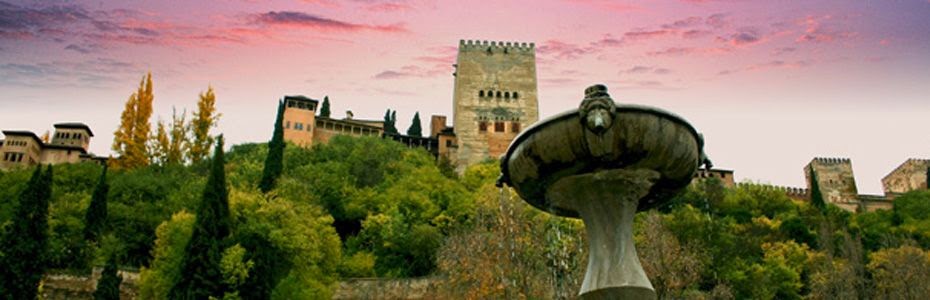
El Albayzin in Granada Spain is a wonderful neighborhood to explore on foot. While strolling along the whitewashed streets, visitors can admire old Moorish homes, beautiful fountains, and attractive plazas. Among the more renowned plazas is the Plaza de San Nicolas. It is at this plaza that the Mirador de San Nicolas can be found. This "mirador," or lookout point, offers amazing views of the Alhambra, especially at sunset.

 The Albaycin is like a different world within Granada. This is due to the strong Muslim influence in this area. It was the place where the first Ziri court was built in the eleventh century.

The city descended from Saint Nicholas to the banks of the River Darro. The Albaycin featured luxurious carmenes and public baths, like the Banuelo

There is a lot to see in the Albaicin Quarter, including remnants of an old gate, Puerta Elvira, to the city and numerous cisterns that harken back to days gone by.

Despite the development that followed the Christian conquest, the Albayzín still bears witness to the medieval Moorish settlement, as its urban fabric, architecture and main characteristics (form, materials, colours), were not changed when it was adapted to the Christian way of life, to survive as a remarkable example of a Spanish-Moorish town.


Nowdays, Albaycin Bajo has a very North African feel, and you will find kebabs and falafel on the local restaurant menus. As for the shops, they offer all kinds of things, including Moroccan handicrafts. Many are found along Calle Caldereria Nueva, which extends from the Albaicin to some of the city's more modern neighborhoods.


Next to the Arabic Quarter in Granada it's  Sacromonte. A neighborhood of sorts, Sacromonte is known for its gitano (gypsy) heritage and features some interesting caves. It's also where the Granada flamenco shows take place.