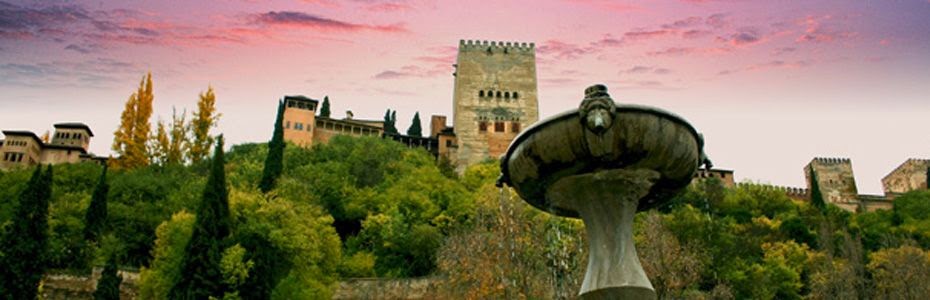
Must see places in Andalusia, Spain

If you are a muslim traveller or an islamic architecture lover those are the 7 things you must see in Granada

Top 10 foods to try in Morocco

One of the great cuisines of the world, Moroccan cooking abounds with subtle spices and intriguing flavour combinations.

Top Five Must See Things in Cordoba, Spain

Cordoba قرطبة in the Andalucia province of southern Spain is a city with more than 2,500 years of developed history.

ChefChaouen, the blue city in Morocco

Located just a few hours by bus from Tangier and far enough off the beaten track to dissuade many tourists, Chefchaouen is quiet enough for those visitors overwhelmed by the busy medinas of Fez and Marrakech, and has just enough of what is quintessentially Moroccan to be of interest to other travelers looking for something a bit more authentic.

Fes, Morocco

The most mystical of Morocco's imperial cities, Fez. Capital and spiritual center of Morocco, this city is situated in a narrow valley against the backdrop of the Middle Atlas

Mostrando entradas con la etiqueta arabic heritage. Mostrar todas las entradas

lunes, 22 de febrero de 2016

Dar al Horra Palace - Islamic things you must visit in Granada


Picture shared via http://alhambracadabra.blogspot.com.es


Text via www.granadatur.com 

It was built in the 15th century on the remains of the destroyed palace of the Ziri kings. It very interesting as it is the only one, out of several which were in the Albayzin, which has been preserved. The name “Dar-al-horra” (House of the Honest Lady) seems to honour one of its inhabitants: Aisha, the mother of King Boabdil, the last of the Muslim monarchs in Spain.

After the conquer of Granada in 1492 by the Catholic Monarchs, the Muslims ceded the Palace an the surrounding houses to the Kings’ secretary, Hernando de Zafra. Afterwards, Queen Isabella decided to found ther the Santa Isabel la Real Convent. The building was owned by the religious order until the beginnings of the 20th century when it was purchased by the government. Today it has been catallogued as Heritage of Cultural Interest.


Picture shared via http://alhambracadabra.blogspot.com.es

Its structure and decoration is the characteristic of the Nasrid art. It has two floors in two of its sides and a tower in its North side. We can admire a central courtyard or patio, two “porticos” in the lower sides and a little pool with fountain by the South portico.

Picture shared via http://alhambracadabra.blogspot.com.es

The North side is the most interesting in the building; it has two floors and a tower. On the ground floor, the portico is formed by three horseshoe’s archs on columns and it is covered by a magnificent Arab-style ceiling made of simple wood and decorated with geometrical shapes. 

In the centre a door with horseshoe arch gives access to a rectangular hall with side rooms and a watchpoint in the centre from where one can see part of the district. The different rooms are divided with archs and covered by Arab-style ceilings. In some walls there still are some Arabic inscriptions.

miércoles, 14 de enero de 2015

Alcázar of the Christian Monarchs, Cordoba (Spain)

The Alcázar de los Reyes Cristianos (Spanish for "Alcázar of the Christian Monarchs"), also known as the Alcázar of Córdoba, is a medieval Alcázar located in the historic centre of Córdoba, Spain next to the Guadalquivir River and near the Grand Mosque. The Alcázar takes its name from the Arabic word القصر (Al-Qasr, meaning "the Palace"). The fortress served as one of the primary residences of Isabella I of Castile and Ferdinand II of Aragon.

History

In early medieval times, the site was occupied by a Visigoth fortress. When the Visigoths fell to the Umayyad conquest of Hispania, the emirs of the Umayyad Caliphate in Damascus rebuilt the structure. The Umayyads fell to the Abbasid Caliphate and the surviving member of the Umayyad Dynasty, Abd ar-Rahman I, fled to Córdoba. Abd ar-Rahman I's successors established the independent Caliphate of Córdoba and used the Alcázar as their palace. 

The city subsequently flourished as an important political and cultural center, and the Alcázar was expanded to a very large compound with baths, gardens, and the largest library in the West. Watermills on the nearby Guadalquivir powered water lifting to irrigate the extensive gardens.
In 1236, Christian forces took Córdoba during the Reconquista. In 1328, Alfonso XI of Castile began building the present day structure on part of the site for the old fortress. Other parts of the Moorish Alcázar had been given as spoils to the bishop, nobles, and the Order of Calatrava. Alfonso's structure retained only part of the Moorish ruins but the structure appears Islamic since Alfonso used the Mudéjar style.
The Alcázar was involved in the civil war where Henry IV of Castile faced a rebellion that backed his teenage, half-brother Alfonso. During the war, the Alcázar's defenses were upgraded to deal with the advent of gunpowder. At the same time, the Alcázar's main tower, now known as the "Inquisition Tower" was constructed.

Henry's successor, Isabella and her husband Ferdinand used the Alcázar for one of the first permanent tribunals of the Spanish Inquisition and as a headquarters for their campaign against the Nasrid dynasty in Granada, the last remaining Moorish kingdom in the Iberian Peninsula. The Inquisition began using the Alcázar as one of its headquarters in 1482, converting much of it, including the Arab baths, into torture and interrogation chambers. The Inquisition maintained a tribunal here for three centuries. Boabdil was held prisoner here in 1483 until he promised to make Granada a tributary state. When Boabdil refused to surrender his kingdom in 1489, the Christians launched an attack. Isabella and Ferdinand's campaign against Granada succeeded in 1492. The same year, the monarchs met Cristóbal Colón in the Alcázar as he prepared to take his first voyage to the Americas.
The Alcázar served as a garrison for Napoleon Bonaparte's troops in 1810. In 1821, the Alcázar became a prison. Finally, the Spanish government made the Alcázar a tourist attraction and national monument in the 1950s.

Description

The Alcázar centers on the Patio Morisco ("Courtyard of the Moriscos"), another popular feature. There are two towers: the Torre de los Leones ("Tower of the Lions) and the Torre de Homenaje ("Tower of Homage"). The latter has Gothic features including an ogival ceiling.
A series of Roman mosaics and a Roman sarcophagus are displayed in the Inquisition Tower.

More about Córdoba in our blog:

viernes, 14 de noviembre de 2014

The Banuelo baths, the old arab baths in Granada

Walking along the street you can easily miss the door of these impressive and well-preserved Arab baths, the Banuelo, also known as Aammim Alyawza (Banos del Nogal).
The Banuelo baths are located at the bottom of a private house in the Carrera del Darro, at the foot of the Alhambra, and show how skilled the Spanish Arabs were a thousand years ago.

The Banuelo of Granada is one of the few such establishments that were saved from destruction by

the Catholic Monarchs, as among the Christians they had a reputation comparable to that of brothels.

These Arab baths have survived because of the building on top of it of a private home, commenced almost from the day of the Spanish occupation of the city.

 In 1918, The Banuelo was declared a National Monument and was restored by the architect Balbas. Surprises to be found in The Banuelo are their large size and good level of conservation. Beautiful porticos are based on the Arab style.


Construction of The Banuelo seems to date from the Eleventh Century. The baths are undoubtedly the oldest and best-preserved Arab baths in Spain, and the oldest work of Muslim Granada.

You can access The Banuelo through a small house, renovated in the Christian era. Its rooms are rectangular and it has various chambers with brick arches, with a star-like window in the roof for allowing in light.

The entrance to the Banuelo is free

Texto by: www.lovegranada.com
Phothos by: Feroen Florijn

martes, 11 de noviembre de 2014

Travel the halal way and discover The Alpujarras, Granada

Granada, Spain is an extraordinary city that invites travelers to explore its rich heritage and scenic attractions. Just south of the city, huddled on the southern hillside of the vast Sierra Nevada Mountain Range, sits the much lesser known magical and charming region of the Alpujarra.

Some fifty villages of varying sizes and common cultural features make up this historic area that spills over both the provinces of Granada and Almería. The villages also share a common topography; they perch along the slopes of two dramatic ravines that extend from the peaks of the Sierra Nevada and cut southeastward to form the basins of the Guadalfeo and the Andaraz Rivers.

The name for this region may come from the Arabic al-buqscharra, which could be translated as “the land of the pastures” given the abundance of water found in this fertile zone. The area is not easy to reach; the steep mountainside landscape has obliged villagers to build a network of terraces and ditches to optimize irrigation. The hilly geography does not facilitate the use of machinery for carrying out agricultural work. While this has posed a historical challenge to agriculturists, it has helped preserve a natural aura that offers observers a peek into a distant age that appears lost in time.

After the fall of the Nasrid Kingdom of Granada in 1492, the Andalusia Muslims were required by law to convert to Catholicism under the Catholic monarchs after 1502. Muslims who refused to leave their Andalusia homes to go to Northern Africa were known as Moriscos.

They remained in this area until 1568, when the Morisco revolt lead by Abén Humeya (whose Christian name of Fernando de Válor) was violently defeated a year later by the Spanish king’s army. After the Castilian victory, by order of the crown, two Morisco families were permitted to continue living in each town to teach new Christian settlers from Castile, Leon, and Galicia how to work the challenging terraced land and maintain the irrigation system so vital to the local agriculture. Unfortunately, the plan proved unsuccessful, and the traditional farming systems were lost in favor of methods adopted from the central and northern regions of the peninsula.


The influence of Northern Africa has been maintained in the region’s architecture, clearly related to the Berbers, with homes that appear stacked or overlapping to form passageway-tunnels called “tinaos”. Houses also have flat roofs called launa, which are covered with gravel, affording residents rooftop terrace spaces. There are no tiles here, and the home’s design takes advantage of every square meter, each one playing a necessary and functional role. Other Northern African elements that have been maintained in the Alpujarra include many cooking traditions, the use of jarapas (carpets made of recycled fabric), and the area’s place names such as Alcolea, Bentarique, La Taha, Ohanes…

Jarapa, traditional carpet from the Alpujarras
The most common way to visit the area is through the town of Lanjarón, one of the Alpujarra’s entry points along with Órgiva. Beyond this spa-town (famous throughout Spain for its mineral water), visitors follow winding mountain roads to cross the historic Tablate Bridge, the scene of the last great battle between Christian soldiers and Alpujarra Moriscos, the confrontation which ended the so-called “Morisco rebellion” in the third quarter of the 16th century.


A few kilometers past the bridge and around a tight curve, the scenic Poqueira River gorge offers fantastic views. The gorge is home to three towns: Capileria, bubión, and Pampaneira, names that may sound Gaelic but which are Arab in origin.

Visitors continuing on their journey may reach Trevélez, peninsular Spain’s highest town, a place famous for its hams. Hams here are cured in the cold, dry air of the Sierra Mountains, which is where the name jamón serrano comes from.


It is not surprising that this region has left an indelible impression on many observers, such as the Granada writer Pedro Antonio de Alarcón, who in 1874 published the book La Alpujarra about this area of the Sierra Nevada Mountains. In 1957, British writer Gerald Brenan published South from Granada, a story that takes place in the Alpujarra town of Yegen and which was made into a movie in 2003 by Fernando Colomo. The former drummer for the music group Genesis, Chris Stewart, who is a resident in the local mountain town of Órgiva, has recently published two enjoyable novels. They narrate the adventures of a cosmopolitan Englishman who decides to move to the seclusion of these mountains with his wife and daughter. Driving Over Lemons: An Optimist in Andalucia and A Parrot In the Pepper Tree are both highly recommendable titles.


The scenic mountain atmosphere of the Alpujarra and its charming villages make for enjoyable and memorable travel experiences. This is a recommended trip for anyone visiting Spain and a must for those going to Granada.

Text by: donquijote.org http://www.donquijote.org/culture/spain/places/cities/la-alpujarra 
Photos by: Vive Alpujarra Proyecto https://www.facebook.com/Vive.Alpujarra